
AI Search
Salesforce Now Sells AI Visibility Tracking: What Palmata Means for a Local Business
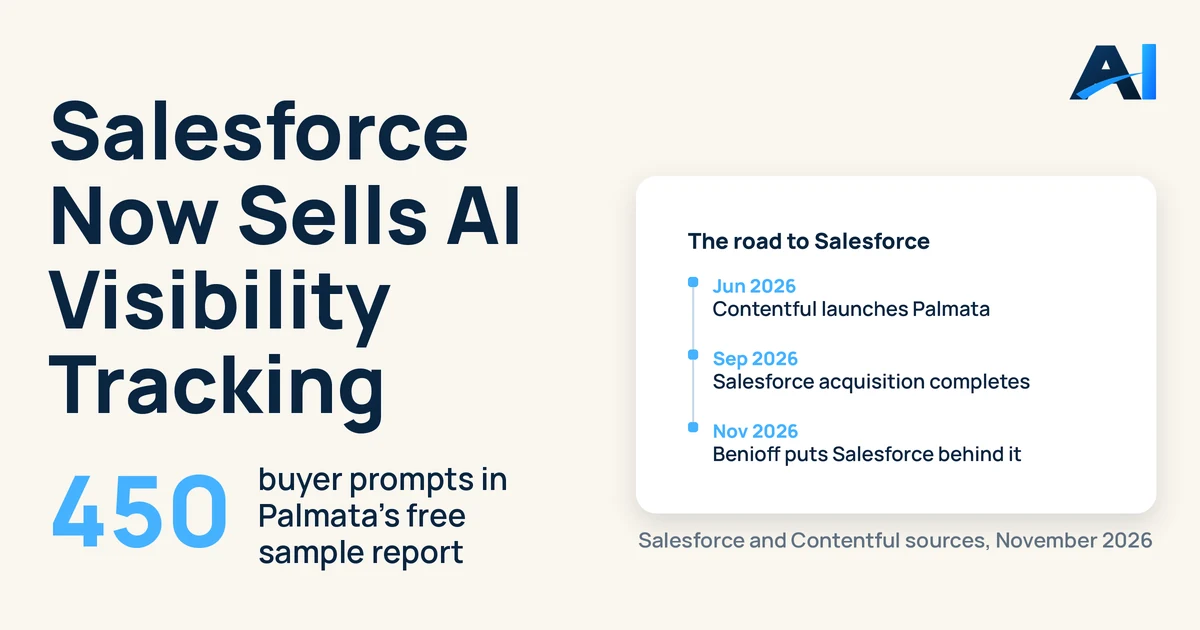
Salesforce has put its name and its CEO behind Palmata, the AI visibility platform Contentful launched on June 23, 2026; Salesforce completed its acquisition of Contentful on September 1, 2026. Palmata runs buyer questions through ChatGPT and Gemini and reports where a brand is named, what is said, and who is named instead, for enterprise marketing teams. This guide covers what it does, who it is for, what it costs, and what a local service business should do with the same three questions at its own scale.
The short answer
Salesforce now sells a platform called Palmata that tracks how AI answer engines describe a company. It researches a brand, builds a list of buyer questions, runs them through ChatGPT and Gemini, and reports where the brand is named, what is said about it, and which competitors show up instead, with a prioritized list of fixes. It is built for enterprise marketing teams, and paid access is by quote, with no published price. A local service business is not its buyer. What matters locally is the signal: Salesforce now treats "what does AI say about your business" as a product category. The questions Palmata answers for a national brand are the same three questions a local business needs answered at its own scale: does AI name me, what does it say, and who does it name instead.
What happened
Palmata is not brand new, and the timeline matters. Contentful, a content platform company, launched Palmata on June 23, 2026, aimed at marketing teams at large organizations. Its launch partners were The Atlantic, Box, Dataiku, Docusign, Marketbridge, and Telus Digital. Salesforce had already agreed to buy Contentful on June 1, 2026, and completed the acquisition on September 1, 2026. Salesforce then showcased Palmata at Dreamforce 2026 as part of Marketing Cloud.
On November 18, 2026, Salesforce CEO Marc Benioff posted the launch video to his own audience with the pitch that customers are no longer searching, they are asking, and that AI answers are the new search. The story trended the next day. So the news is not that a tool appeared. The news is that Salesforce has put its name and its CEO behind AI visibility as a thing a business is expected to manage.
What Palmata does
Salesforce's product page describes Palmata as an AI visibility and answer engine optimization platform. In plain terms, it works in four steps:
- It researches your brand, your market, and your competitors, and builds a prompt list across the buyer journey, the questions a buyer would ask an AI assistant at each stage.
- It runs those questions and records how the engines represent you: mention rate, citation rate, sentiment, and an accuracy score for what the answers claim about you.
- It benchmarks you against competitors, showing share of voice across the platforms it tracks and who gets named when you do not.
- It turns the findings into recommended actions, ranked by priority, and can simulate the projected impact of a content change before you make it.
It also alerts teams when answers contain misinformation or outdated information about the brand. A hands-on account from TELUS Digital, one of the launch partners, describes reports grouped into topics.
One detail worth checking if you read about Palmata this week: the summaries circulating on social media say it tracks four engines, ChatGPT, Perplexity, Gemini, and Claude. Salesforce's own product page names two, ChatGPT and Gemini, and its pricing page is structured the same way, with the free sample covering ChatGPT only. When a vendor's own page and the social summary disagree, believe the vendor's page, and treat the gap as a reminder to check any tool's engine list before paying for it.
Who it is for, and what it costs
Palmata is a standalone product. Salesforce's FAQ says you do not need an existing Salesforce or Contentful account to start, and it is also built into Marketing Cloud for the companies that already run it. The intended user, though, is clear from every source: marketing teams at organizations large enough to have product lines, regions, and competitor sets to steer research across. That is who the launch partners are, and that is who the product page speaks to.
Pricing confirms it. Anyone can run one free sample report on their own brand at palmata.ai. The sample tracks 450 prompts, shows where you stand against competitors, and recommends content actions. It is a one-time report: it cannot be refreshed or rerun. Everything beyond that is an Enterprise plan with personalized pricing. There is no published monthly price. Paid use runs on credits at $10 each, with a basic report costing 30 credits and an advanced report 60, bought as an annual commitment sized to the organization.
A platform built to audit 450 buyer questions across a national brand's product portfolio is the wrong tool, at the wrong price shape, for a dental practice, a roofing company, or a law firm with two offices.
What it means for a local business
Three things, and only three.
First, validation. When Salesforce enters a category, the category stops being a niche concern. Your customers are already asking ChatGPT and Google AI which plumber, dentist, or mover to call, and the answers name some businesses and skip others. That is now a boardroom topic at enterprise companies, not a fad to wait out.
Second, the local contest is a different contest. Palmata tracks how engines describe a brand across hundreds of national buyer questions. A local business is named, or not, on a handful of questions that include a place and a service: the best HVAC company in a given city, an emergency plumber near a neighborhood, a med spa that offers a specific treatment. The sources behind those answers are mostly not the company's own marketing content. They are its Google Business Profile, its reviews, directories, and a small number of pages that state plainly what it does and where. The work that moves a local business is smaller and more concrete than an enterprise research platform, and most of it is fixing facts and coverage, not producing more content.
Third, a caution that came up in this week's discussion and is worth keeping: AI visibility rests on ordinary visibility. If a business is hard to find, thinly reviewed, and described inconsistently across the web, no AI tool will recommend it, because the engines build their answers from that same record. Palmata's own design admits this: it reads publicly available information about a company and works out what to fix in it. The fix list is the product. The tracking is the scoreboard.
What to do at local scale
The local version of Palmata's audit fits in an afternoon, and most of it is free:
- Ask the three questions. Does AI name your business when a buyer asks for your service in your city? What does it say about you? Who does it name instead? Our free AI visibility check is a first cut at those same questions for your business. It is not a 450-prompt enterprise audit, and it does not pretend to be.
- Fix wrong facts at the source. If AI describes your services, hours, or service area incorrectly, the error lives somewhere it reads: your website, your profiles, or a directory listing. Correct it there, not in a dashboard.
- Close the coverage gaps the answers expose. If competitors are named because they have a page, a profile, or a review record you lack, that is the work list, in the order the answers reveal it.
- Retest on a rhythm. One report, free or paid, is a snapshot. The value is in checking again after you fix things. Monthly is enough at local scale.
For owners who want the findings turned into a written plan, that is what our AI Visibility Audit is: the same questions, worked through by a person, with the fixes listed in order.
What not to bother with
- Do not buy an enterprise AEO platform to solve a local visibility problem. The audit depth is real, and it is depth you cannot act on: a local business has a short list of fixes, and it needs them done, not simulated.
- Do not shop on engine count. A tool that tracks four engines and reads thin sources loses to a clear record on the two engines your customers actually use. Check what a tool reads, not just where it looks.
- Do not treat any single report as the strategy. Visibility moves, and a stale snapshot quietly becomes wrong.
Questions owners ask
Is Palmata free?
Partly. Anyone can run one free sample report on their own brand at palmata.ai, covering 450 prompts in ChatGPT, with competitor comparisons and recommended actions. It is a one-time report that cannot be refreshed or rerun. Ongoing use is an Enterprise plan priced by quote; Salesforce does not publish a monthly price.
Can a local business use Palmata?
You can run the free sample, and it will show you something real about how ChatGPT describes your business. The paid product is built and priced for enterprise marketing teams, with annual credit commitments sized to an organization's scope. For a local business, the same three questions can be answered with a free visibility check and an afternoon of fixes, at no platform cost.
Does Salesforce selling this change what a local business should do?
It changes the urgency, not the work. The work is unchanged: be findable, be described consistently and accurately everywhere AI reads, carry a review record that names your services, and check what AI says about you on a rhythm. What changed this week is who else now agrees that this matters. When Salesforce sells the scoreboard, the game is not experimental anymore.
You do not need an enterprise platform to answer the three questions for your own business. Our free AI visibility check answers them at local scale: whether AI names your business when a buyer asks, what it says about you, and who it names instead. It is a first cut, not a 450-prompt enterprise audit, and for owners who want those findings worked through by a person, with the fixes listed in order, that is our AI Visibility Audit.
Want a second set of eyes?
We can review where AI may help your business, prioritize realistic opportunities, and decide whether the best first step is an integration, an AI workflow, or custom software.
Book Free AI AuditLooking specifically at ChatGPT and AI discovery? Request a free AI Visibility Checker. You can also see how we improve AI search visibility.
Sources and further reading
The guides combine practical implementation advice with the public references below. Hypothetical examples are labeled and are not customer results.
- Salesforce: Palmata, AI Visibility and Answer Engine Optimization Platform
- Palmata: Pricing
- Contentful: Contentful Introduces Palmata (June 23, 2026)
- Salesforce: Dreamforce 2026, 5 Ways Marketing Cloud Is Building a New Model for Growth (September 29, 2026)
- PR Newswire: The Pacific Financial Group Taps Salesforce and Newly Acquired Contentful (November 12, 2026)