
AI Search
Can You Pay to Be Recommended by ChatGPT? What Ads Buy, and What They Don't
No. OpenAI sells one paid placement, a labeled ad below the answer, and states plainly that ads do not influence its answers. This guide covers what the ad actually is, what it costs, how to spot sellers blurring the line, and what earns the recommendation instead.
The short answer
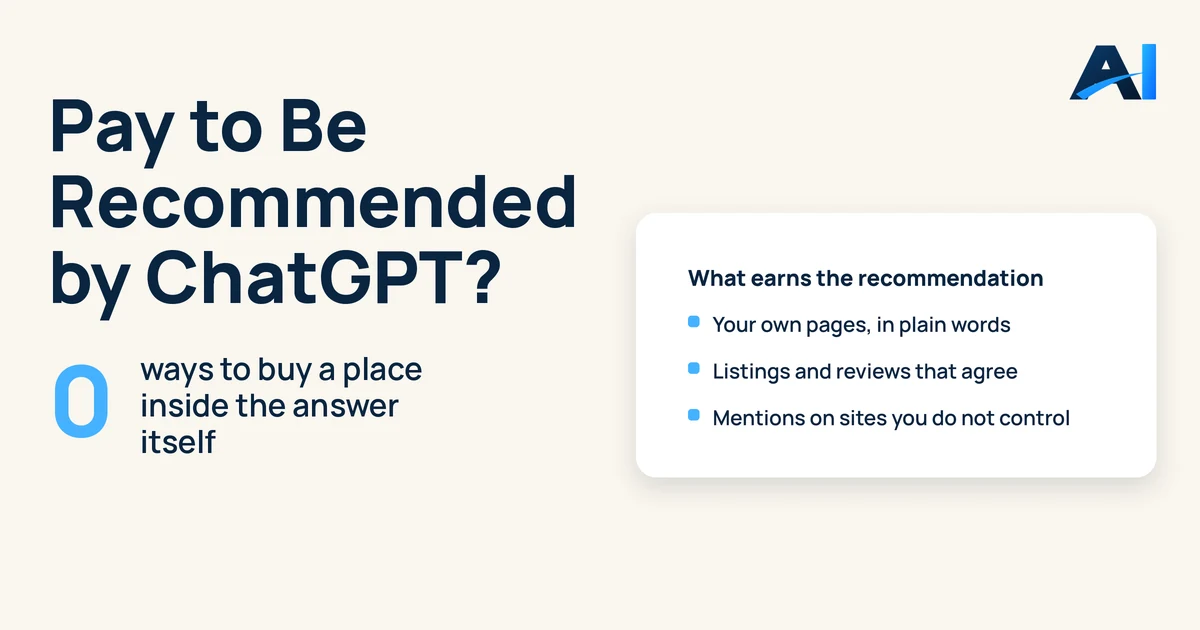
No. You can buy an ad that sits below a ChatGPT answer, clearly labeled as sponsored. You cannot buy a place inside the answer itself. OpenAI states this in plain words on its own help pages: ads do not influence the answers ChatGPT gives, ads run on separate systems from the chat model, and advertisers have no ability to shape, rank, or alter ChatGPT's responses. Seeing an ad also does not mean OpenAI endorses or recommends the advertiser. The recommendation is earned. The box under it is rented. This guide covers what the rented box actually is, what it costs to rent, what a seller is really offering when they promise you the recommendation itself, and what earns the recommendation instead.
What ChatGPT ads actually are
ChatGPT ads are real, and they are new. OpenAI began testing them in the United States on February 9, 2026, for logged in adult users on the Free and Go plans. Through 2026 the test expanded in stages: Canada, Australia, and New Zealand in the spring, then the United Kingdom, Mexico, Brazil, Japan, and South Korea, then 31 European markets in August 2026, with self service buying through OpenAI's Ads Manager opening as each wave settled. Availability still varies by country, and OpenAI's help pages describe the rollout as ongoing.
What a user sees is one ad unit below the end of a response. The unit carries the advertiser's name, logo, a headline, a short description, an image, and a link to a landing page. It is labeled as sponsored and shown separately from the answer above it. OpenAI is also testing a multi-image ad format that appears during image generation, under the same labeling and separation rules.
Who sees ads is as important as where they sit:
- Free and Go plan users, in markets where ads are live. Free users can switch to a no ads option in exchange for lower message limits and reduced access to some tools.
- Plus, Pro, Business, Enterprise, and Education accounts see no ads at all.
- Accounts identified as belonging to people under 18 see no ads.
- Temporary Chats show no ads.
- Ads are not eligible to appear near sensitive topics, which OpenAI lists as personal health, mental health, and politics.
That list decides whether ads are even an option for a given business. A company whose best customers sit on paid ChatGPT plans cannot reach those customers with an ad at any budget, because those accounts never see one. The only way in front of those readers is the answer itself.
What an ad costs, and how the buying works
OpenAI sells these placements through Ads Manager. Per its Ads Basics page, checked November 3, 2026:
- Billing runs on impressions or on valid clicks. Advertisers set a maximum bid for each ad group, a CPM bid for reach campaigns or a CPC bid for click campaigns.
- For CPC campaigns, OpenAI recommends starting with a maximum bid of $3 to $5 USD per click. That is a recommended starting bid from OpenAI's own documentation, not a promised average cost, and competitive topics can run higher.
- When several ads are eligible, a relevance weighted second price auction picks the order, weighing the conversation's topic and intent, the ad's copy and landing page, and the advertiser's own context hints.
- Advertisers receive aggregate reporting only: impressions, clicks, spend, click through rate, and average costs. OpenAI states that advertisers never receive users' chats, chat history, memories, names, email addresses, or precise locations.
Read that as what it is: a new pay per click channel, run much like the early days of search ads. It can put a labeled offer in front of someone at the moment they are asking about a topic. It is a reasonable test for a business that already buys search ads and measures them honestly. What it is not is a lever on the answer above it. The ad system and the answer system are separate, by OpenAI's own description, and no setting in Ads Manager changes a recommendation.
What a seller promising “guaranteed AI placement” is really selling
Because the honest answer is no, this question now attracts offers that blur the line. Owners are being pitched guaranteed ChatGPT placement, paid AI listings, and recommendation packages. Measured against what OpenAI publishes, there is exactly one paid route into ChatGPT, and it is the labeled ad described above, bought from OpenAI itself. Anything else sold as placement inside the answer is one of three things:
- An ad, relabeled. Some sellers resell or manage the same Ads Manager placements and describe them in language that sounds like a recommendation. Ask to see a screenshot of the placement. If it carries a sponsored label and sits below an answer, it is an ad, whatever the invoice calls it.
- Paid mentions on other websites. Roundups, directories, and articles on third party sites do feed the answers ChatGPT builds, which is why they have value when they are genuine. A paid spot presented as independent editorial is a different thing from an earned mention, and an undisclosed one puts both the publisher and the business at risk. It is also not a ChatGPT placement. It is a web page, bought.
- Nothing measurable at all. A monthly fee for a listing in a system OpenAI does not run, with reporting that counts the ad impressions or the bought pages and calls them recommendations. Ask what you can verify yourself: the exact questions, the exact answers, and whether your name appears inside the answer text or only next to it.
The test that cuts through all three is simple. Run the questions your customers ask, in a fresh ChatGPT session, and look at where your name appears. Inside the answer, in the model's own words, is a recommendation. Below it, labeled, is an ad. Any seller's report should survive that same five minute check.
What earns the recommendation instead
ChatGPT builds its answers from what it can find and check on the web, the same evidence base covered in the general checklist for improving visibility in AI search. Three parts of that evidence do most of the work for a local service business:
- Your own pages, in plain words. One page per service, stating what the work is, where you do it, and the terms a customer asks about first. An answer engine can only recommend a business it can describe accurately.
- Listings and reviews that agree with each other. Your profile, directory listings, and reviews telling the same story about your name, services, and area. Conflicting facts give the engine a reason to name a competitor whose record is clean. The guide to AI visibility services covers what this work includes when it is hired out.
- Mentions on sites you do not control. Roundups, trade publications, and local coverage naming your business for the work you want. This is the slowest part to build and the part no ad spend substitutes for.
None of that is a guarantee either, and any firm offering one is selling the same story as the placement sellers above. It is a record the engine can verify, built in the open, and it is the only route OpenAI's documentation describes.
Find out whether you have earned it yet
Before spending on either ads or visibility work, see where you stand. Ask ChatGPT the questions your buyers ask, the way the guide to testing your ChatGPT visibility walks through, and write down who gets named. For a scored version across ChatGPT, Perplexity, and Gemini, the free AI visibility check returns one score per platform. If the names in the answer are your competitors, the fix is the evidence work above, and the AI Opportunity Audit maps it in priority order. An ad can run alongside that work if the channel fits your business. It just cannot replace it, and now you know exactly why.
Questions owners ask
Can I pay OpenAI directly to be named when someone asks for a recommendation?
No. OpenAI sells one paid placement, the labeled ad below an answer, through Ads Manager. Its help pages state that ads do not influence ChatGPT's answers and that advertisers have no ability to shape, rank, or alter responses. There is no paid tier, listing fee, or partner program that puts a business inside the answer.
If I run ChatGPT ads, will ChatGPT start recommending me too?
No. OpenAI describes the ads system and the chat model as separate systems. Running ads buys impressions and clicks on the sponsored unit, reported in aggregate. It does not change what the model says about your business, in either direction. Businesses get recommended for the evidence the engine can find and verify, whether or not they advertise.
Should a local service business run ChatGPT ads at all?
That depends on the same math as any pay per click channel: what a click is worth to you, whether your customers are on the Free and Go plans that see ads, and whether your topic is one ads are eligible to appear near, since health, mental health, and politics conversations are excluded. OpenAI's own recommended starting bid for click campaigns is $3 to $5 per click, which is a sane test budget yardstick. Just budget it as advertising, measured on clicks and calls, and never as a way to buy the recommendation itself.
Want a second set of eyes?
We can review where AI may help your business, prioritize realistic opportunities, and decide whether the best first step is an integration, an AI workflow, or custom software.
Book Free AI AuditLooking specifically at ChatGPT and AI discovery? Request a free AI Visibility Checker. You can also see how we improve AI search visibility.
Sources and further reading
The guides combine practical implementation advice with the public references below. Hypothetical examples are labeled and are not customer results.