
AI Search
AI Visibility for HVAC Companies: How to Be the Company AI Recommends
When a homeowner asks ChatGPT, Perplexity, Gemini, or Google AI Mode for an HVAC company, most independent companies never get named. The research says it is an evidence problem, not a reviews problem: AI names the companies it can verify. This guide works through the five fixes in the order that does the most work first.
The short answer
When a homeowner asks ChatGPT, Perplexity, Gemini, or Google AI Mode for an HVAC company, the answer names a short list, and most independent HVAC companies are not on it. That is not mainly a reviews problem or a website problem. It is an evidence problem. AI names the companies it can verify: a complete Google Business Profile, listings that match each other, reviews that name the actual work, and website pages that state plainly what the company installs and repairs, where, and on what terms. National brands and franchise networks win today because they supply that evidence at scale. An independent company can supply it locally, and the fixes below are in the order that does the most work first.
The questions homeowners actually ask
Nobody asks AI for an HVAC company in the abstract. They ask when the house is too hot, too cold, or a system has died, and the wording matters because each version pulls a slightly different short list:
- "Best HVAC company near me"
- "AC stopped working, who can come today in [town]"
- "Who replaces furnaces in [town]"
- "How much does a new AC system cost"
- "HVAC company with a maintenance plan, who is good"
- "What do customers say about [company name]"
The emergency questions are worth money tonight. The replacement questions are worth money this month, and they are usually the biggest tickets an HVAC company sells. The maintenance plan question is worth money all year, because it is the customer who stays. The last one is the reputation check a homeowner runs right before calling, and AI answers it by summarizing reviews and listings, not by reading a slogan. If your facts are thin or conflicting, that summary will be thin or wrong, and the homeowner calls the next name.
Traditional search ranked pages. AI search builds an answer from sources it can check, then names a few businesses. Missing the list does not mean you slipped a few spots. It means you never entered the conversation. Seasonal demand makes this sharper for HVAC than for most trades: the first heat wave and the first cold snap are when the most homeowners ask at once, and the short list at that moment is built from evidence gathered long before.
Why the national brands win today
The clearest count of this comes from 5W's HVAC and Plumbing AI Visibility Index 2026, reported by Plumbing and Mechanical in May 2026. 5W ran more than 65 consumer and trade prompts across ChatGPT, Claude, Perplexity, and Google AI Overviews in the first quarter of 2026. Three findings matter for an independent HVAC company:
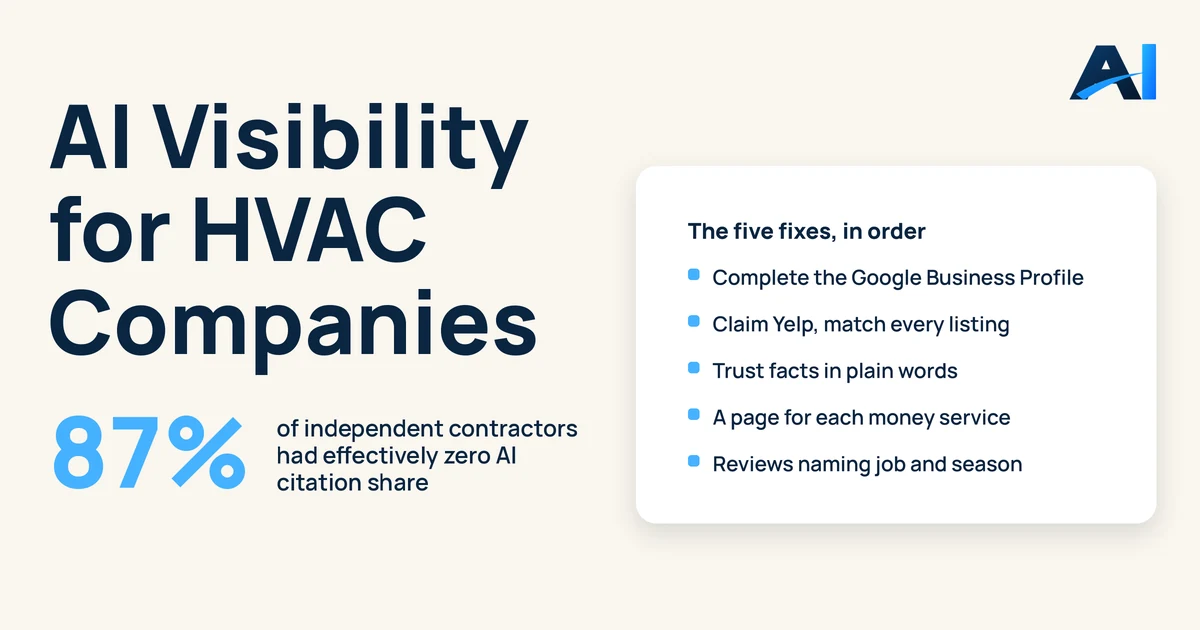
About 87 percent of independent HVAC and plumbing contractors had effectively zero AI citation share in their own metro and category. That held even for contractors with more than 800 five star Google reviews and thirty years of customer relationships.
A small set of national brands owns most of the surface. Plumbing and Mechanical names the pattern directly: the answer is Roto-Rooter, or Mr. Rooter, or ARS / Rescue Rooter, or One Hour Heating and Air Conditioning, or Service Experts, or Benjamin Franklin Plumbing, plus the contractor software platforms ServiceTitan, Housecall Pro, and Jobber on trade questions. Three of those national brands, Roto-Rooter, ARS / Rescue Rooter, and Mr. Rooter, together took an estimated 19 percent of all consumer intent AI citations in the study.
Local reputation alone was not enough. The study puts the reason on entity strength: the structured, consistent record of a business across the web, including reference listings, trade press coverage, and matching business facts everywhere. It estimates that advantage at roughly eight times for the national networks, and says plainly that strong local reviews without that record underneath do not produce citation share. Franchise networks reinforce each other here: an umbrella brand's companies in different trades cite and support one another in ways a single trade company cannot copy directly.
Read that correctly. It does not say an independent cannot be named. It says reviews by themselves will not do it, and the missing layer is verifiable facts, repeated consistently in the places AI checks. That layer is buildable without a franchise fee, and it is what the rest of this guide covers.
What AI reads to pick a local HVAC company
BrightLocal analyzed nearly 2 million AI citations in research published in August 2026: 60,970 checks across 1,355 business locations in the US, UK, and Australia, covering Google AI Overviews, Google AI Mode, and ChatGPT. Two findings set the fix order.
Google Business Profile is the largest single directory source. It made up 28.63 percent of all citations in that study and was cited for 94.17 percent of the businesses checked. BrightLocal's own summary is that the Google Business Profile is the source of choice for Google's own AI tools.
Yelp is second overall, and first for ChatGPT. Yelp made up 9.53 percent of all citations, was the second most used source for Google's AI tools, and was the most used source for ChatGPT in the same study. One profile done well does not cover every engine.
The closest owner guides on this query agree on the rest of the stack. Bear North Digital's HVAC guide, for example, builds its answer on five things: entity authority in the databases AI checks, review volume and what the reviews actually say, website content that shows real expertise, structured data that states the business facts in machine readable form, and consistent name, address, and phone data across listings. Put together, the picture is consistent across the research. AI picks the HVAC company whose services, service area, availability, and reviews it can confirm in more than one place. The fixes below follow that order.
The five fixes, in order
1. Complete the Google Business Profile first
It is the most cited directory source in the BrightLocal data, and it is free. Fill in every field: primary category (Heating Contractor or HVAC Contractor, whichever fits the work), each service offered as its own service entry, service areas, hours including emergency availability stated honestly, phone, and website. Add real photos of the team, trucks, and finished installs. If the profile lists a service in general terms only, split it out. "HVAC services" is a category. "AC repair," "furnace replacement," and "heat pump installation" are services a homeowner actually asks about, and the profile should name them the way the customer does. Keep the seasonal facts current: a profile that still shows winter hours and furnace copy in the first heat wave is telling AI, and homeowners, that nobody is minding it.
2. Claim Yelp and make every listing match
ChatGPT's reliance on Yelp in the BrightLocal data makes an unclaimed or stale Yelp page a direct cost, even for owners who get no work from Yelp itself. Claim it, then run the same check across Angi, the Better Business Bureau, Facebook, Bing Places, Apple Maps, and any trade directory that lists the company. The business name, address or service area, phone number, and website address should read identically everywhere. AI cross checks these records. When the website says one phone number and a directory says an old one, the engine has no reason to trust either, and it names a company whose record is clean. The general checklist for improving visibility in AI search covers this consistency pass step by step.
3. Put the trust facts in plain words, where they can be read
On the website and on the profiles, state in plain text: the license type and number where state rules allow publishing it, that the company is insured, whether emergency calls are taken and what that actually means (same day, after hours, weekends), how pricing works (written estimate before work, what the diagnostic or service call fee covers and whether it applies to the repair), what warranties cover equipment and labor, and what a maintenance plan includes and how often visits happen. Do not bury these facts in images or leave them to a reviews page. Emergency availability and maintenance plans are the two HVAC facts homeowners ask AI about most outside of price, and neither can be quoted from a photo of a truck. Only publish what is true for your company. A stated fact AI repeats that turns out to be wrong costs more than a missing one.
4. Give each money service its own page
A single services page with a bulleted list gives AI almost nothing to match against a specific question. For most HVAC companies that means a page each for AC repair, AC replacement and installation, furnace repair and replacement, heat pumps, and maintenance plans, plus indoor air quality or duct work where the company genuinely wants more of that work. Each page should state what the job involves, the signs it is time to call, how the visit works, what affects the price, how long it usually takes, and which towns it covers. Answer the questions customers ask before they call, in plain language, starting with a direct answer. That structure also serves the homeowner reading the page directly, which is the point: the page AI can quote is the same page a person finds useful. Add the structured data that states the business and service facts in machine readable form, the LocalBusiness and Service schema the owner guides on this query treat as basic. Companies that serve several towns should add area detail only where it is genuine, not a set of near identical city pages with the town name swapped.
5. Build reviews that name the job and the season
Reviews still matter, and HVAC reviews carry a detail other trades do not: they prove the company shows up in the season when it is hardest to get anyone. The count bar is real across home services: in the Cheers September 2026 baseline of 9,435 Google AI Mode answers for home services questions, the median business AI named carried 226 Google reviews. That figure is for home services as a whole, not HVAC alone, and the fuller breakdown is in how many reviews a business needs to show up in AI search. What to do with that: ask after every finished job, as a habit rather than a campaign, and make it easy for customers to name the work and the town in their own words. A review that says the company replaced a furnace on the coldest weekend of the year, or got the AC running the same day during a heat wave, tells the next answer what the company does and when it can be counted on. "Great service" tells it nothing. Reply to reviews, including the critical ones. Never buy reviews or offer incentives for them. The profile is the asset the whole effort rests on.
Test yourself in five minutes
You can see where you stand today, free, without any tool. Open ChatGPT and Google AI Mode in a private browser window so past searches do not skew the answers. Ask "best HVAC company in [your town]" and "AC repair near me, who can come today." Write down every business named and whether yours is one of them. Then ask "What do customers say about [your company]?" and check the hours, services, and service area in the answer against the truth. Wrong details almost always trace back to a listing that was never updated. Repeat the test with a replacement question, "who should replace my furnace in [your town]," because replacement answers often name a different short list than repair answers.
For a scored version across ChatGPT, Perplexity, and Gemini, run the free AI visibility check. HVAC companies sit inside the broader home services work, and the check shows which engines name you today and which names they give instead. Time the retest honestly: run it once before the next seasonal rush, not during it, so the fixes have time to be recrawled.
What not to bother with
Three shortcuts surface in the research and are worth naming so no one sells them to you. First, guaranteed AI placement. No engine sells a place in its organic recommendations, and a firm promising one is promising something it does not control. Second, reviews alone as a strategy. The 5W finding stands: a large review count without consistent facts and service pages underneath it did not produce citation share for the contractors in that study. Reviews are fix five of five for a reason. Third, chasing every new AI tactic before the basics are done. The guides ranking on this query list advanced ideas, from forum posting to video content, but every one of them puts the profile, the listings, and the service pages first. A company with a half empty profile gains nothing from the advanced layer.
If you would rather have it done
The sequence above is the whole job: profile, listings, trust facts, service pages, review habit, then retesting on a schedule. Owners who want it worked through in order, with the gaps written up first, can start with the AI Opportunity Audit, which maps what AI says about a business today and the fixes in priority order. The guide to AI visibility services explains what hiring that work out normally includes, so the options are clear either way.
Questions HVAC owners ask
Can a small HVAC company actually get named by AI, or is it all national brands now?
Yes, a small company can be named. The 5W index shows nationals taking a large share and most independents at zero, but the same research ties the gap to missing verifiable facts, not to size itself. The local question is also narrower than the national one. AI answering for one town needs a short list for that town, and a complete local record competes there first. The seasonal pattern helps a prepared independent: when demand spikes, homeowners ask for whoever can come today in their town, and a profile that states availability honestly is evidence a national brand page cannot supply for that town.
Which matters more for an HVAC company, Google reviews or the Google Business Profile?
Both, in that order of operations. In the BrightLocal August 2026 data, Google Business Profile was the largest single directory source across the engines studied, so the profile is the first fix. Reviews are the strongest signal inside and around that profile, and the reviews that help most name the job, the town, and the timing. Complete the profile first, then build the review habit on top of it.
How long before these fixes change what AI says?
There is no promised timeline, and any firm offering one is guessing. AI answers shift as their sources are recrawled and rechecked, which is uneven across engines and towns. Work through the fixes in order, then retest monthly with the same questions from the same towns, and judge movement over a quarter. A single check proves little in either direction. For HVAC, judge over a season as well as a quarter: a fix made in spring should be visible in the answers by the summer rush if it is going to show, and that is the honest test.
Want a second set of eyes?
We can review where AI may help your business, prioritize realistic opportunities, and decide whether the best first step is an integration, an AI workflow, or custom software.
Book Free AI AuditLooking specifically at ChatGPT and AI discovery? Request a free AI Visibility Checker. You can also see how we improve AI search visibility.
Sources and further reading
The guides combine practical implementation advice with the public references below. Hypothetical examples are labeled and are not customer results.
- Plumbing & Mechanical: 87% of HVAC and Plumbing Contractors Are Invisible When Homeowners Ask AI (5W HVAC and Plumbing AI Visibility Index 2026, Version 1)
- BrightLocal: Where to get local citations for AI search (August 2026)
- Bear North Digital: AI Search for HVAC: Showing Up in ChatGPT and AI Overviews
- HVAC Webmasters: AI SEO for HVAC Companies (2026 Guide)
- Cheers: Market Baseline, September 2026 (review counts of businesses named in Google AI Mode answers)