
AI Search
How to Get Your Business Cited by Perplexity: A Local Business Guide
Perplexity is the easiest AI engine to check and the fastest one to move on, because it shows its work: every answer carries numbered citations to the pages it used. This guide covers the four steps to becoming one of its sources, in the order that does the most work first.
The short answer
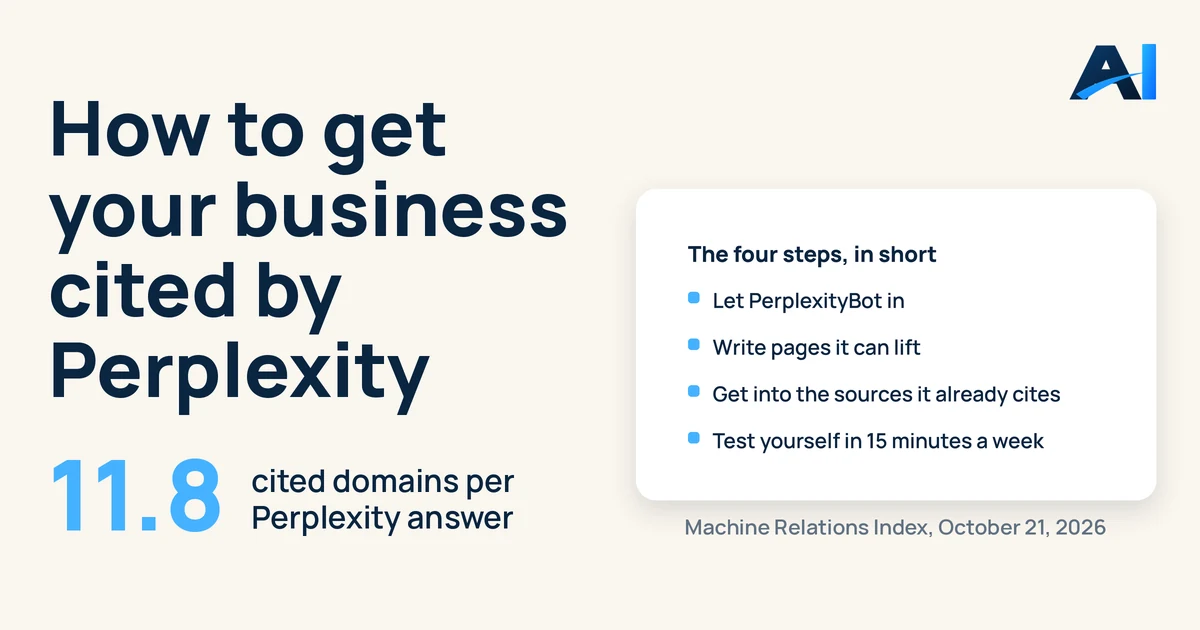
Perplexity is the easiest AI engine to check and the fastest one to move on, because it shows its work. Every answer is built from a live web search and carries numbered citations to the pages it used. To get your business cited, three things have to be true. Perplexity's crawler has to be able to reach your site. Your pages have to answer a customer's exact question in the first lines, with specific, dated facts it can lift. And your business has to show up, with matching facts, on the sites Perplexity already cites for questions like yours. None of that requires being in a model's training data, and none of it can be bought. The steps below are in the order that does the most work first.
How Perplexity builds an answer
Perplexity describes itself as searching the internet in real time for each question, then summarizing what it found, with citations and links to the original sources in every response. That design matters for a small business in two ways.
First, there is no waiting for a new model. A page can become a source once it has been crawled and it matches the question being asked. Citepoint's October 2026 guide puts the practical timeline at days to weeks once a page is discovered, depending on how quickly it is crawled. Treat that as a range from practice, not a promise. No engine publishes one.
Second, the citation is visible. When ChatGPT names a business, you see a name. When Perplexity uses a page, you see a numbered source you can click, open, and study. That makes Perplexity the best diagnostic tool a local business has: you can see exactly which pages it trusted for your customers' questions, including your competitors' pages, and work from that list instead of guessing.
One caution from the data. Perplexity reads widely and cites selectively. The Machine Relations Index, in its October 21, 2026 release covering 6,847 observed Perplexity answers, counted about 11.8 cited domains per answer, and 16,383 distinct domains cited in total, roughly twice as many as the other engines it tracks on similar run counts. The same release found that most domains only Perplexity cited were cited once: of 8,132 domains no other engine cited, 54.5 percent appeared exactly once across the whole window. A single citation is a start. Being cited again and again is the result that counts, and it goes to sources Perplexity already leans on.
Step 1: Let PerplexityBot in
Perplexity documents two agents on its official crawler page, updated October 29, 2026.
PerplexityBot is the crawler that surfaces and links websites in Perplexity search results. Perplexity states it is not used to crawl content for AI foundation models, and recommends allowing it in your site's robots.txt file and permitting requests from its published IP ranges. If PerplexityBot is blocked, your site is kept out of the results it builds from.
Perplexity-User is different. It visits a page when a person's question needs it, and may link that page in the answer. It is not used for crawling or training, and because a user requested the fetch, Perplexity says it generally ignores robots.txt rules.
The check takes five minutes. Open your robots.txt file and confirm there is no rule blocking PerplexityBot. Then check your firewall or CDN settings, because a site can allow the bot in robots.txt and still block it at the firewall, and Perplexity publishes WAF guidance and IP lists for exactly that case. Perplexity notes that robots.txt changes can take up to 24 hours to show up in its systems, so retest the next day, not the next hour. If a website vendor manages your site, ask them the question in those words: is PerplexityBot allowed in robots.txt and at the firewall?
Step 2: Write pages it can lift
Perplexity cites passages. A page earns a citation when a passage on it supports a sentence in the answer, stated plainly enough to quote. The guides that hold page one for this query agree on the shape, and it matches what Perplexity's own design rewards:
- Answer the exact question in the first two sentences of the page. No preamble, no history of your industry, no story before the answer.
- Put specifics right after the answer: what the service includes, what it costs or what drives the price, which towns you serve, how long the work takes, what the terms are. Vague claims cannot be cited because there is nothing to check them against.
- Show a visible published or updated date, and keep the facts behind it current. Perplexity's search can be narrowed by recency, and a page carrying a fresh date over stale prices is worse than an honest older page.
- Build one page per question. A single services page with a bulleted list gives Perplexity almost nothing to match against "who replaces water heaters in [town]" or "what does rodent proofing cost." One clear page per money service, written the way customers ask, is the unit it retrieves.
- Say the same facts everywhere. Your website, Google Business Profile, Yelp page, and directory listings should carry the same business name, phone, services, and service area. Perplexity reads several pages per answer, and when the sources agree about you, you are a safer business to name.
The broader version of this work, covering all the engines at once, is the general checklist for improving visibility in AI search. This guide stays on Perplexity because its mechanics are the ones you can verify by hand.
Step 3: Get into the sources it already cites
Your own site is only part of the pool. In the Machine Relations Index release of October 21, 2026, editorial publications took 30.4 percent of Perplexity's classified citations, vendor-owned sources took 28.4 percent, and community platforms took 12.7 percent. Community sources matter more on Perplexity than on ChatGPT, where the same release puts them at 4.0 percent. Reddit alone was cited in 22.1 percent of the 6,847 Perplexity answers observed.
Peec AI's analysis of 30 million AI citations, published in March 2026 and reported by Citepoint, found the same pattern from the domain side: Perplexity's five most cited sites were Reddit, YouTube, LinkedIn, Wikipedia, and G2. G2 appeared in Perplexity's top five and in no other engine's, which points to Perplexity leaning on review and comparison sites for business questions.
For a local service business, the translation is direct. Run your customers' questions in Perplexity first and write down which sites the answers cite. For local questions those lists usually include review sites, directories, and roundup or list pages alongside business websites. Then do the unglamorous work: claim and complete your profiles on the cited review and directory sites, keep the facts on them identical to your website, earn real reviews there, and take part honestly in the community threads your customers read, as yourself, saying who you are. Being included accurately on a page Perplexity already cites is worth more than another page on your own site that nobody cites yet.
Step 4: Test yourself in 15 minutes a week
Perplexity re-searches for every answer, so citations move as pages are published and updated. A weekly check is enough, and it is free.
- Open Perplexity in a private or logged out browser window so your history does not skew the answers.
- Ask the three to five questions your customers actually ask, in their words: "best [service] in [town]," "[service] near me," "what do customers say about [your business]."
- For each answer, write down three things: whether your business is named, whether any page of yours is cited, and which businesses and pages are cited instead.
- Run each question more than once across the month. A single answer can differ from the next, so judge by how often you appear, not by one good or bad run.
- When a competitor is cited and you are not, open the cited page and note what it states more clearly than yours. That gap is next week's fix.
Keep the log in a simple spreadsheet with the date, the question, and the result. After a month you have a citation rate for Perplexity, which is a number you can watch move. For a scored version across ChatGPT, Perplexity, and Gemini in one run, the free AI visibility check returns a separate score per engine, so you can see whether Perplexity is ahead of or behind the others for your business.
What not to bother with
Three offers and habits waste money here. First, guaranteed Perplexity placement. Perplexity does not sell places in its organic citations, and a firm promising one is promising something it does not control. Second, a press release as a citation strategy. In the Machine Relations Index release, wire and press release distribution took 0.5 percent of Perplexity's classified citations. A release can put a fact on record. It is a very small part of what Perplexity cites. Third, blocking Perplexity-User and thinking you have opted out, or blocking PerplexityBot by accident with a copied robots.txt file and never checking. The first does not do what owners expect, because that agent generally ignores robots.txt by design. The second quietly removes you from the results entirely.
If you would rather have it done
The sequence above is the whole job: crawler access, liftable pages, presence on the cited sources, and a weekly retest. Owners who want it worked through in order, with the gaps written up first, can start with the AI Opportunity Audit, which maps what AI says about a business today and the fixes in priority order. The guide to AI visibility services explains what hiring that work out normally includes.
Questions owners ask
How long does it take to get cited by Perplexity?
There is no published timeline and no promised one. Because Perplexity searches the live web for every answer, a new or updated page can be cited once it has been crawled and matches the question. Citepoint's October 2026 guide puts that at days to weeks in practice, depending on how quickly the page is discovered. Judge your own progress with the weekly test above over a month or a quarter, not from a single check.
What is the difference between being named and being cited in Perplexity?
A citation means one of your pages is listed as a numbered source for the answer. A mention means the answer names your business, which can happen because a review site, directory, or roundup page that Perplexity cited named you. Both are worth having. A citation sends the reader to your own page. A mention on a trusted third-party page is often how a local business gets named before its own site is strong enough to be cited, which is why step 3 comes before most owners expect it to.
Does Perplexity use my website to train its AI models?
Perplexity's crawler documentation, updated October 29, 2026, states that PerplexityBot is not used to crawl content for AI foundation models, and that Perplexity-User is not used for web crawling or to collect content for training either. PerplexityBot exists to surface and link websites in Perplexity search results. Allowing it is what makes your site eligible to appear there.
Want a second set of eyes?
We can review where AI may help your business, prioritize realistic opportunities, and decide whether the best first step is an integration, an AI workflow, or custom software.
Book Free AI AuditLooking specifically at ChatGPT and AI discovery? Request a free AI Visibility Checker. You can also see how we improve AI search visibility.
Sources and further reading
The guides combine practical implementation advice with the public references below. Hypothetical examples are labeled and are not customer results.
- Perplexity: Perplexity Crawlers (official documentation, updated October 29, 2026)
- Citepoint: How Perplexity Chooses Its Sources (and How to Become One)
- AuthorityTech: How to Get Cited by Perplexity (reporting the Machine Relations Index, October 21, 2026)
- Okara: How to Get Cited by Perplexity (2026 Guide)
- SEO Spider: How to Get Your Business Mentioned in Perplexity AI