
AI Search
Why Does ChatGPT Recommend Your Competitors? How to Find Your Reason
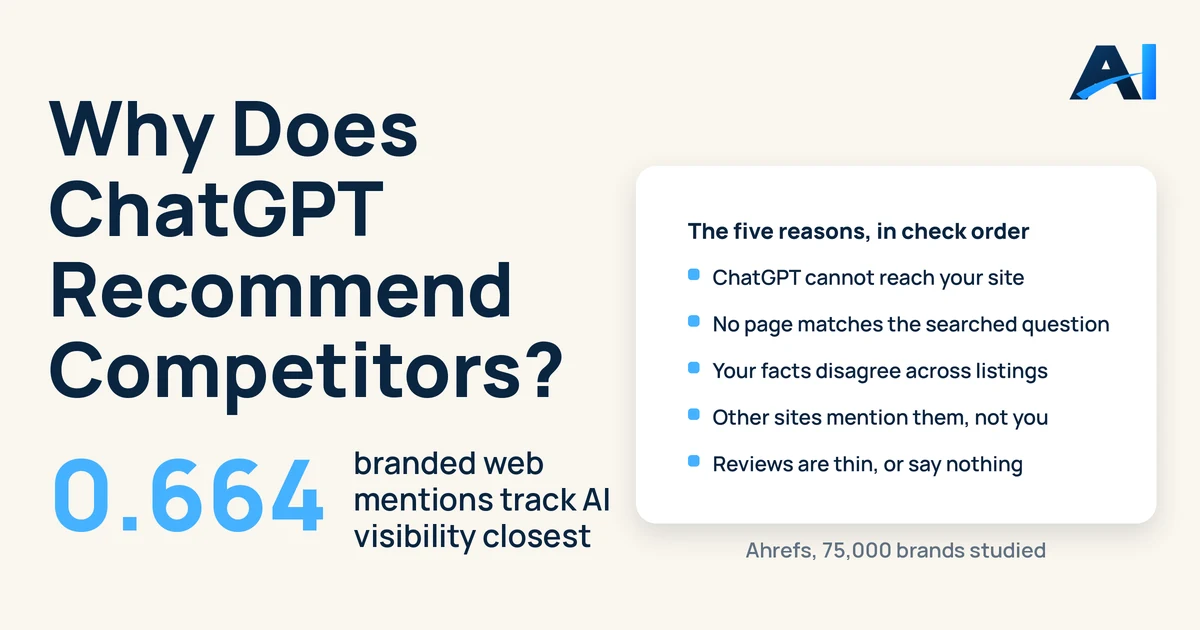
ChatGPT is not judging who does the best work. It builds a recommendation from evidence it can find and check, and a competitor gets named when their evidence is clearer, more consistent, or simply present. This guide works through the five reasons a competitor wins, in the order to check them, each with the five minute check that proves or clears it.
The short answer
ChatGPT is not judging who does the best work. It is building an answer from evidence it can find and check: the pages it retrieves when it searches, the listings and reviews those pages point to, and what the model already learned in training. Your competitor gets named when the evidence for them is clearer, more consistent, or simply present, and yours is thin, conflicting, or missing. That is good news in one specific way. Evidence can be checked, reason by reason, and most of the reasons below can be fixed in an order. This guide is the diagnosis: five reasons a competitor wins the recommendation, and the five minute check that proves or clears each one.
First, make sure the gap is real
One answer that names a competitor and skips you proves almost nothing. Answers change between runs, between accounts, and between wordings of the same question. OpenAI's own search help page explains part of why: when memory is enabled, ChatGPT may use saved memories when it rewrites a question into searches, and it uses general location information from the asker's IP address. Your own logged in account, asking from your own town, with your history in it, is not what a new customer sees.
So before diagnosing anything, run the test properly. Ask your main buyer question ("best [trade] company in [your town]," or the service version your customers actually use) at least three times in a fresh chat, ideally logged out or with memory off. Vary it once, the way a second customer would word it. Then ask a branded question: "What does [your business] do, and where?" If ChatGPT describes you accurately by name but never names you on the buying question, you have the classic pattern this guide covers: known, but not recommended. If it cannot describe you accurately either, start with reasons 1 and 3 below, because the basic record is the problem. The full testing method is in how to test your visibility in ChatGPT and AI search.
How a recommendation is actually built
OpenAI does not publish a ranking formula, and anyone reciting exact ranking factors for ChatGPT is describing something OpenAI has not released. What OpenAI does document, on its own help and developer pages, is the machinery:
ChatGPT may search the web automatically when a question would benefit from current information, and answers that use search may include citations. It can also be told to search. An answer with sources shown was built from pages it retrieved for that question. An answer with no sources was built from what the model learned in training, which has a cutoff and favors businesses that were written about widely and consistently before it.
Your question is not the search. When ChatGPT uses search partners, OpenAI says it typically rewrites the prompt into one or more targeted queries, sends those, reads the first results, and may send more specific follow up queries. A homeowner's "who can fix my AC today near me" becomes shorter, more literal searches, and the pages that rank for those rewritten searches are the candidates for the answer. Your pages have to match the rewritten question, not just the one the customer typed.
Access is a gate, not a detail. OpenAI's crawler documentation states it directly: OAI-SearchBot is the crawler used to surface websites in ChatGPT's search features, and sites that opt out of OAI-SearchBot will not be shown in ChatGPT search answers. OpenAI also notes it can take about 24 hours for a robots.txt change to take effect in its systems, and its search help page adds that placement is not guaranteed even when a site is eligible.
Put those three together and the shape of every diagnosis below falls out. A competitor wins when they pass the access gate, match the rewritten searches, and present facts that agree across the sources the answer was built from. You lose on whichever of those is weakest. The five reasons are those weak points, in the order to check them.
Reason 1: ChatGPT cannot reach your site
If OAI-SearchBot is blocked, your own pages cannot appear in ChatGPT search answers at all, no matter how good they are. Blocks are usually accidental: a robots.txt rule written to stop training crawlers that also catches the search crawler, a firewall or bot protection setting, or a hosting security rule. Note the distinction OpenAI itself draws: GPTBot is the training crawler and is a separate choice. Blocking GPTBot does not block search. Blocking OAI-SearchBot does.
The five minute check. Open your site's robots.txt (yourwebsite.com/robots.txt) and look for OAI-SearchBot and for any wildcard rule that disallows crawling. Then ask whether anything else sits in front of the site: a CDN, a firewall, or a security plugin with bot blocking turned on. If you have server or CDN logs, search them for OAI-SearchBot and look at the status codes it got. A page that returns an error or a challenge to that crawler is a page ChatGPT cannot use.
What clears it. No mention of OAI-SearchBot in robots.txt, no blanket block, and logs showing it fetching pages successfully. If it is blocked, allowing it is fix number one, ahead of everything else in this guide, because every other fix depends on being reachable. Allow about a day for the change to register on OpenAI's side before retesting.
Reason 2: No page of yours matches the question ChatGPT actually searched
Because ChatGPT rewrites the buyer's question into its own targeted searches, the contest is over the rewritten wording. A competitor with a plain page titled and written around the service, the town, and the customer's situation will be retrieved for those searches. A business whose website talks in general terms ("quality solutions," "your trusted partner") or keeps everything on one long services page gives the retrieval step nothing specific to match. This is also why a business can appear for the broad question and vanish the moment the buyer adds a detail, like a price range, a timeframe, or a type of job: the competitor has a page that answers the detail, and they do not.
The five minute check. Take the answers that skipped you and open their sources. Note the pages ChatGPT cited and the wording those pages use. Then compare your own site honestly: is there one page that states, in plain words near the top, what the service is, who it is for, where you do it, and what it involves? Read your main service page as a stranger. If the first screen could belong to any company in any town, that is the finding.
What clears it. One strong page per money service that answers the buyer's actual questions directly, in the words customers use. Not one page per search variation: one clear page per real service, with the specifics on it (what the job involves, what affects the price, how fast you can come, which towns). The fixes are worked through in order in the checklist for improving your visibility in AI search.
Reason 3: Your facts do not match across your listings
An engine recommending a business has to be confident it is looking at one business. When your name, address or service area, phone number, hours, or service list differ between your website, your Google Business Profile, Yelp, and other directories, the records fight each other, and the engine names the competitor whose record is clean. This is the most common quiet killer for local businesses, because listings drift: an old phone number on one directory, a pre move address on another, services listed differently in three places.
For local questions the stakes are concrete. In BrightLocal's August 2026 study of nearly 2 million AI citations, the Google Business Profile made up 28.63 percent of all citations and was cited for 94.17 percent of the businesses checked, and Yelp made up 9.53 percent and was the most used source for ChatGPT. Those two profiles are not side channels. For a local recommendation they are primary evidence, and if they disagree with your site, the answer is built on the disagreement.
The five minute check. Search your business name and town in a private browser window. Open the top results (your site, Google Business Profile, Yelp, Facebook, any trade directory) and put five facts side by side: name, address or service area, phone, hours, and the services named. Any mismatch is a finding. Then ask ChatGPT "What does [your business] do, and where is it?" and compare its answer against the truth. Wrong facts in the answer almost always trace back to a listing that was never updated.
What clears it. Identical core facts everywhere, corrected at the source listing, not just on your website. Fix your own pages first, then each profile you control, in the order a customer would meet them: Google Business Profile, Yelp, then the rest.
Reason 4: Other sites talk about your competitors, and not about you
ChatGPT's shortlist is largely a summary of what other websites say. Roundups, "best of" lists, review platforms, directories, trade press, and community threads are the pages its searches retrieve for recommendation questions, and a competitor named on those pages gets carried into answer after answer. A business absent from them has only its own site arguing for it.
The strongest published evidence on this point comes from Ahrefs, which studied 75,000 brands and found that branded web mentions (your name appearing anywhere on the web, linked or not) tracked AI Overview visibility more closely than any other factor it tested, at a correlation of 0.664, against 0.218 for backlinks. Ahrefs stresses that correlation is not causation, and big brands naturally collect both mentions and visibility. Read it as direction, not proof: being talked about by others travels with being named by AI, far more than link counts do.
The five minute check. Go back to the sources under the answers that skipped you. For each cited page, mark whether it names you, names the competitor, or neither. The pages that appear again and again, naming them and not you, are your specific gap. It is usually a short list: one or two roundups, a review platform category page, a directory you never claimed.
What clears it. Presence on those specific pages, earned honestly: pitch the roundup author with real facts, claim and complete the directory and platform profiles, take part in community threads with your affiliation disclosed. Do not buy placements disguised as editorial coverage, and never fake mentions. An engine that surfaces the evidence can surface the fakery too, and the slow honest version is the one that holds.
Reason 5: Your reviews are thin, or they do not say anything
Reviews are the proof layer a recommendation leans on, and two different weaknesses hide under "reviews." The first is volume. In the Cheers September 2026 baseline of 9,435 Google AI Mode answers to home services questions, the median business AI named carried 226 Google reviews. That is a home services figure across trades, not a threshold any engine publishes, and plenty of businesses with fewer reviews do get named. But a profile with a handful of reviews is asking the engine to recommend it on very little evidence. The breakdown of what counts actually show is in how many reviews a business needs to show up in AI search.
The second weakness matters more and is cheaper to fix: content. A review that says "great service" gives an answer nothing to work with. A review that names the job, the town, and the outcome ("replaced our water heater the same day in [town]") tells the next answer what the company does, where, and how it performed. When ChatGPT answers the reputation question ("What do customers say about [company]?") it summarizes reviews. Thin reviews produce a thin summary, right at the moment the customer is deciding.
The five minute check. Read your ten most recent reviews on Google and Yelp as if you were the engine. Do they name specific jobs and places? Is the count anywhere near the competitors ChatGPT named instead? Search one of those competitors' profiles and compare honestly: count, recency, and how many reviews describe real work.
What clears it. A steady asking habit after finished jobs, on the platforms your customers use, making it easy for them to describe the work in their own words, and replies to reviews including the critical ones. Never buy reviews or pay for them with incentives. The profile is the asset the whole recommendation rests on, and a bought profile risks the asset itself.
What to fix first once you know your reason
Work in the order the answer is built, not in the order that feels most productive:
- Access first. If OAI-SearchBot is blocked, nothing else matters for search answers. This is a settings fix, usually minutes.
- Your own pages and facts. The category sentence, the service pages, the trust facts in plain text. You control these completely, and every other fix builds on them.
- Listings consistency. Google Business Profile and Yelp first, then every directory that lists you, matched to the website fact for fact.
- The cited third party pages. Start with the two or three sources that kept appearing in answers that skipped you. That is a named list now, not a general publicity campaign.
- Reviews as a habit. Volume and detail build over months. Start the habit now, judge it over a quarter.
One honest limit: if the answers that skip you show no sources, they came from training, and training changes on the model's schedule, not yours. You cannot edit that memory. What you can do is win the search path, which is the path used for local, current, and specific questions, and let consistent coverage accumulate. Change one or two things at a time and rerun the same questions, so you can tell what actually moved. And expect the realistic win: being named alongside the competitor, on the shortlist, is what progress looks like first. Named instead of them, every time, is not a thing anyone can promise.
For a scored version of the diagnosis, across ChatGPT, Perplexity, and Gemini, run the free AI visibility check. It names who AI names instead of you, which is the starting evidence for every check in this guide. Owners who want the reasons worked through and written up in priority order can start with the AI Opportunity Audit.
Questions owners ask
My competitor is not better than us. Why does ChatGPT act like they are?
It is not acting on quality at all. ChatGPT builds a recommendation from the evidence it can retrieve and verify: the pages its searches find, the listings that agree with each other, the reviews that say something specific. A competitor with clearer, more consistent evidence is easier to recommend, whatever the quality gap at the actual work is. That is why the fix is evidence work, not a complaint to OpenAI, and why it is fixable.
Why does ChatGPT give a different answer every time I ask?
Because the answer is rebuilt per run. The wording of the question, the asker's general location, whether search runs for that question, and, on a logged in account, saved memories can all change the searches ChatGPT sends and the pages it reads. OpenAI documents the query rewriting and the memory and location inputs on its search help page. Judge your standing on repeated runs of the same questions over time, never on one answer.
Can I pay, or ask OpenAI, to recommend my business instead?
No. There is no documented way to request or buy a place in ChatGPT's recommendations. OpenAI's position, covered in the guide to whether you can pay to be recommended by ChatGPT, is that ads are labelled, sit separate from the answer, and do not influence it. What you control is the evidence: crawler access, your pages, your listings, your mentions, and your reviews. A firm offering a guaranteed recommendation is selling something it does not control.
Want a second set of eyes?
We can review where AI may help your business, prioritize realistic opportunities, and decide whether the best first step is an integration, an AI workflow, or custom software.
Book Free AI AuditLooking specifically at ChatGPT and AI discovery? Request a free AI Visibility Checker. You can also see how we improve AI search visibility.
Sources and further reading
The guides combine practical implementation advice with the public references below. Hypothetical examples are labeled and are not customer results.
- OpenAI: Searching the web with ChatGPT (help center)
- OpenAI: Overview of OpenAI Crawlers (OAI-SearchBot and GPTBot)
- Ahrefs: An Analysis of AI Overview Brand Visibility Factors (75K Brands Studied)
- BrightLocal: Where to get local citations for AI search (August 2026)
- Cheers: Market Baseline, September 2026 (review counts of businesses named in Google AI Mode answers)