
AI Search
AI Visibility for Pest Control Companies: How to Be the Company AI Recommends
Type A Media's Q4 2026 index of 106 US pest control companies (384 answers) and ContentMonk's study of 599 ChatGPT and Google answers show a field split into several small contests, by engine and by residential versus commercial buyer. This guide covers both studies, the order AI reads a pest control company in, and the five fixes in that order.
The short answer
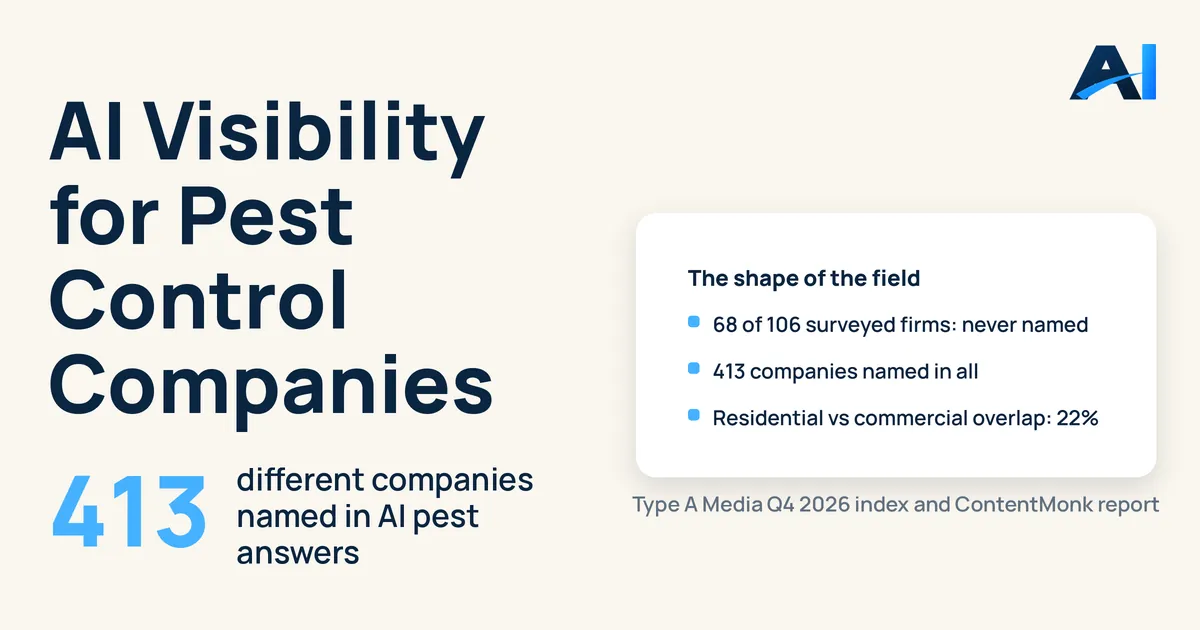
Pest control answers are lopsided. In Type A Media's Q4 2026 index of US pest control, 68 of 106 firms surveyed never appeared in a single AI answer, and the three names at the top, Orkin, Terminix, and Rentokil, took half, 43 percent, and 28 percent of answers between them. But the same research holds the opening for an independent: answers named 413 different companies in all, most of them firms that were not even in the survey, and a second study found that the companies AI names change almost completely between residential and commercial questions and between ChatGPT and Google. There is no single list to break into. There are several small contests, each one local, and most local companies have not entered any of them yet.
The questions customers actually ask
Homeowners ask in the middle of a problem:
- "Best pest control company in [city]" (the generic question)
- "Who can get rid of [termites, bed bugs, rodents, cockroaches, mosquitoes] in [city]?" (the pest question)
- "Pest control safe for [kids, pets] in [city]" (the safety question)
- "How much does pest control cost in [city]?" (the price question)
- "Pest control company that comes out [today, this week] near me" (the urgent question)
Commercial buyers ask a different set:
- "Pest control for [restaurants, warehouses, apartment buildings] in [city]"
- "Pest control company that provides documentation for health inspections"
- "Monthly pest control service for a [property type] in [city]"
Treat those as two separate competitions, because the measurements say they are. ContentMonk's pest control study (30 questions asked in 10 metro areas, repeatedly, across ChatGPT and Google, 599 answers recorded) found that inside the same city, the companies named for commercial work overlapped with the residential set by only 22 percent.
Why the nationals win the generic question
Type A Media compared 106 US pest control companies across 128 prompts and 6 buyer personas, analysing 384 answers. The shape of the results:
- 14 of 15 national and multi-state franchises were named (93.3 percent), against 35.8 percent of firms across the whole market.
- Regional and local firms did far worse in the survey set: 19 of 68 appeared at least once (28 percent).
- Size tracked visibility closely. Of the largest firms by website traffic, 19 of 22 were visible (86 percent). Of mid-size firms, 10 of 57 (18 percent). Of small firms, 2 of 11 (18 percent).
- 135 of the 384 answers (35 percent) named no firm at all.
- Orkin's own website was the single most cited source in the study, with 119 citations.
Read that as a description of the generic, national question, not of your market. The prompts that produced those numbers ask about pest control in general and about the US as a whole. The local question behaves differently, and the study's own detail proves it: across the 249 answers that named any company, 413 different companies were named, and 375 of them were not among the 106 firms surveyed. That is the contest an independent can enter.
ChatGPT and Google are running different contests too
ContentMonk asked identical questions, in the same markets, at the same time, and compared what came back:
- The two engines agreed on 15.2 percent of the companies they named. 259 companies appeared only in ChatGPT's answers and 163 only in Google's.
- Their sources barely overlap either. ChatGPT's most cited sources were Expertise.com, the BBB, and ConsumerAffairs. Google's were Google Maps and Yelp. Neither engine's top ten sources contains the other's top two.
- Neither engine agrees with itself for long. Split in half and compared, ChatGPT reproduced 33.6 percent of its own recommended companies. Google managed 44.7 percent.
The practical meaning: a single check tells you almost nothing, and being absent from ChatGPT says nothing about Google. Fix your Google Business Profile and Yelp for Google, and Expertise, the BBB, and ConsumerAffairs plus your own pages for ChatGPT.
What AI reads for a pest control company, in order
First, the Google Business Profile, which carries Google's answers. Across all local trades, BrightLocal's August 2026 analysis of nearly 2 million AI citations found the profile was cited for 94.17 percent of the businesses checked. For service businesses specifically, Google sources took 45 percent of citations, Yelp 12.3 percent, the BBB 1.6 percent, and Angi 1.4 percent. Cube Creative's audit of independent pest control companies found the basics failing here first: a primary category that did not match the company's main service on more than 30 percent of profiles reviewed, and 56 percent of companies with map data (164 of 291) invisible in the map pack for their own primary service area.
Second, the review and directory platforms, which carry ChatGPT's answers. Yelp appeared as a source in 80 percent of ChatGPT's local answers in BrightLocal's count. For pest control specifically, ContentMonk puts Expertise.com, the BBB, and ConsumerAffairs at the top of ChatGPT's source list.
Third, your own website, which has to say the specific thing. Company-owned sites made up 38 percent of the most cited domains in ContentMonk's study and carried 20 percent of the actual citations, and BrightLocal found about 93 percent of the domains cited were individual business websites. The pages that get used answer a specific question: one pest, one property type, one city. ContentMonk also found that recommendations arrive with a label attached, best for termites, eco-friendly, 24/7 availability, family-owned, and that the labels are lifted from language that already exists in public. If your site never says what you are best for, the label goes to a company whose site does.
Fourth, reviews that name the pest and the place. ContentMonk found a star rating appears in 31 percent of answers. A review that says "they cleared the cockroaches in our restaurant kitchen" teaches an assistant two facts a bare five stars cannot: the pest you handle and the setting you handle it in. One gap worth knowing: a dollar price appeared in only 2 percent of answers, against the study's count of 111,819 monthly US searches asking what pest control costs. Assistants rarely quote a price.
The five fixes, in order
1. Fix the profile and make every listing tell the same story
Start with the Google Business Profile: primary category set to pest control service, every service you actually sell listed, service areas matching the routes you really run. Then work the set AI reads: Yelp, BBB, Angi, Facebook, Expertise and ConsumerAffairs where you qualify, your state pest control association directory, and the National Pest Management Association directory. Same name, same phone, same services, same towns everywhere. When your profile says one thing and Yelp says another, the assistant picks a version, and it may pick the wrong one.
2. Give residential and commercial their own pages
The 22 percent overlap figure is the instruction. A residential page that speaks to homeowners, the pests in houses, safety around kids and pets, and how fast you can come out. A commercial page that speaks to property managers and restaurant owners, scheduled service, documentation for inspections, and the property types you cover. A company with one blended services page is asking the assistant to guess which buyer it serves, and the measured result is that it gets named for neither.
3. Publish one page per pest you actually treat
Termites, rodents, bed bugs, cockroaches, ants, mosquitoes, wildlife where you offer it. Each page answers the question that pest's buyer asks: what the treatment involves, what the customer needs to do before and after, what follow-up looks like, and what it costs or how the price is set. These are the pages that match the pest question, which is the question with real urgency behind it, and they are where your labels come from. Write the page the way your best technician explains the job, and keep treatment claims to what your team can stand behind.
4. Publish the facts only you can publish
Your methods, the products you use and why, your re-service and warranty terms in plain words, your prep instructions, and a price range or a clear statement of how pricing works. Assistants quote the official source when one exists. A page carrying last year's terms is worse than no page, so date these pages and update them when the terms change.
5. Ask for reviews that name the pest, the place, and the result
Ask every customer, the same way, right after the service, and make it easy for them to say what was treated and where, in their own words. Do not hand them a script, do not filter for happy customers, and never offer anything in exchange for a review. Cube Creative's field report found only 11 percent of the pest profiles it audited appeared to have any structured review request process at all, which makes a simple, steady routine a genuine edge in this trade. Reply to reviews, including the critical ones.
For the review engine itself, the pest control review management service covers how that asking and replying runs month to month. This guide's subject is the wider job: being the company the assistant names in the first place.
Test yourself in five minutes
Ask ChatGPT and Google AI Mode the same three questions: "best pest control company in [your city]," "who can get rid of [your highest value pest] in [your city]," and "pest control for [restaurants, apartments, warehouses] in [your city]" if you do commercial work. Run each question three times on each engine, not once. The repeat numbers from ContentMonk's study are the reason: ChatGPT reproduced only a third of its own recommendations between runs, so a single answer is close to noise, and a company named in most runs of a fixed question is a real position. Write down every company named and every source cited, and note whether you appear as a name, as a source, or not at all. The sources column tells you which listing or page to fix next.
For a scored version across ChatGPT, Perplexity, and Gemini, run the free AI visibility check. The pest control overview covers how that check and the follow-on work fit together for a pest company.
What not to bother with
Three traps show up in this trade. First, town pages at volume. Cube Creative's field report found 138 of 300 companies tried to build town pages and only 14 got them right. A page per town that repeats the same text with the town name swapped gives the assistant nothing new to quote and gives you a maintenance problem. Build pages for the towns where you run routes and have something true and specific to say. Second, a guaranteed recommendation. Outputs vary by engine, by phrasing, and by run, as every dataset in this guide shows; anyone who promises a named spot is promising something no one controls. Third, buying visibility on the lead platforms as a substitute for your own record. Being listed where assistants read does matter, but a profile on a platform with no reviews, stale services, and a different phone number than your website is a weaker signal than the same platform filled in properly.
If you would rather have it done
The sequence above is the whole job. Companies that want it worked through in order, with the gaps written up first, can start with the AI Opportunity Audit, which maps what AI says about a company today and the fixes in priority order.
Questions pest control companies ask
Why do the national brands get named instead of local companies?
On the generic question, because their size produces the signals assistants weigh: 14 of 15 national franchises were named in Type A Media's Q4 2026 index, and the largest firms by website traffic were visible at 86 percent against 18 percent for small firms. On the local question the picture changes. Answers named 413 different companies, most of them not in the survey at all.
Do I need different pages for residential and commercial pest control?
If you want both kinds of work, yes. ContentMonk's pest control study found the companies named for commercial work overlapped with the residential set by only 22 percent in the same city. Separate pages that name the buyer, the property type, and the service model give the assistant a reason to name you for each.
How many reviews does a pest control company need to show up in AI search?
There is no published pest-specific threshold, and any exact number offered as one should be treated with suspicion. What the pest data does show is that reviews are a working input, not a decoration: a star rating appeared in 31 percent of answers in ContentMonk's study, and reviews that name the pest and the setting carry facts a rating alone cannot. Volume built steadily, from real customers, is the direction every dataset points.
Want a second set of eyes?
We can review where AI may help your business, prioritize realistic opportunities, and decide whether the best first step is an integration, an AI workflow, or custom software.
Book Free AI AuditLooking specifically at ChatGPT and AI discovery? Request a free AI Visibility Checker. You can also see how we improve AI search visibility.
Sources and further reading
The guides combine practical implementation advice with the public references below. Hypothetical examples are labeled and are not customer results.