
AI Search
AI Visibility for Property Management Companies: How to Be the Company AI Recommends
SOCi's Local Discovery Index AI analysis (about 3,000 multi-location brands, published November 10, 2026) puts property management at the bottom of its five major industry groups for AI visibility, and MarketApts' apartment citation study shows the tenant side runs on different sources than the owner side. This guide covers both, the order AI reads a management company in, and the five fixes in that order.
The short answer
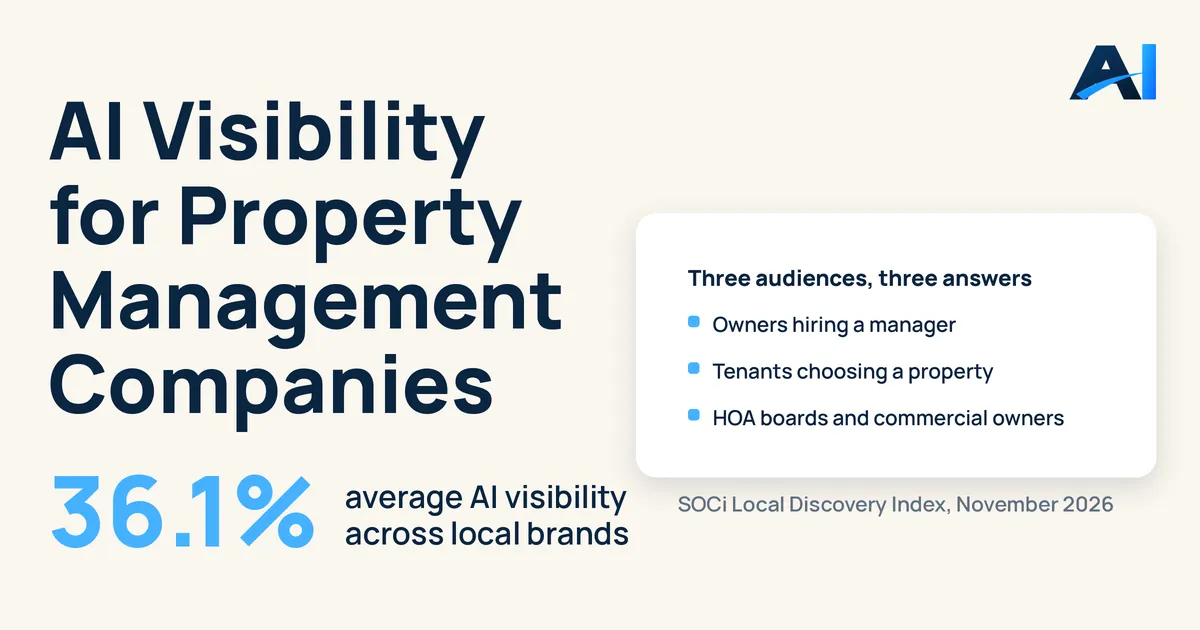
Property management starts from the back of the field. In SOCi's Local Discovery Index AI analysis, published November 10, 2026, average AI visibility across about 3,000 multi-location brands reached 36.1 percent, and across its five major industry groups, property management, with food and beverage, sat at the bottom. The generic question, "best property management company in [city]," is therefore the hardest one in this trade, and it is also the one most managers test first. The openings are the specific questions owners actually ask: what you charge, whether you manage their property type, whether you work with out-of-state owners, and what happens when a tenant stops paying. Those answers are built from published fees, property type pages, and reviews that separate what owners say from what tenants say. A local company that publishes those facts plainly can be named for the specific questions while the national brands divide the generic one.
Three audiences, three different answers
Most trades have one buyer. Property management has three, and an assistant answers each from different material.
Owners hiring a manager. A landlord, often out of state, asking who should manage a rental.
Tenants choosing a property. A renter asking which apartment communities in a city are reputable, good value, or well reviewed. The manager is not the product here, the property is, but the answers shape the reputation an owner later reads.
HOA boards and commercial owners. A board or investor asking who manages associations or commercial buildings in an area, what documentation they provide, and how reporting works.
The questions owners actually ask
CTRL Reality, which measures AI answers for property management companies, publishes the owner questions it tracks, written the way owners write them:
- "Best property management company in [city] for a single family house"
- "Give me a shortlist of property managers in [city] I should interview, with pros and cons"
- "My tenant stopped paying rent and I live out of state. Should I hire a property manager in [city], and who?"
- "My current property manager never answers my emails. Best alternatives in [city]?"
- "How much does a property manager cost in [city], and who has the best rates?"
- "Best property manager for out-of-state investors buying in [city]"
- "Property management companies to avoid in [city], and who to use instead"
First, the shortlist an assistant returns is short, three to five names in CTRL's description, so being sixth is the same as being absent. Second, the last question is a reputation question. The assistant answers it from complaints it can find, on review platforms, the Better Business Bureau, and owner forums such as BiggerPockets and Reddit.
HOA boards ask a smaller set: who manages associations of their size in their area, what financial reporting the board receives, and how meetings, violations, and reserve work are handled.
Why the large firms and the listing platforms win today
Large operators publish the material assistants quote: a page per city, a fee explainer, and owner guides that answer the questions above. Auspia's guide for this trade makes the mechanism plain: an assistant breaks a local question into smaller ones, does the company operate there, does it manage that property type, does it handle maintenance, and is there review or case evidence behind the claims.
On the tenant side, the platforms win instead. MarketApts ran the same renter questions across several US metro areas and tracked what ChatGPT, Google AI Overviews, AI Mode, and Gemini cited across 407 ranked or cited pages. Yelp averaged 16.2 percent of top 10 citations, ApartmentRatings 14.6 percent, Apartments.com 13.0 percent, and Zillow 10.9 percent, and those three review and listing names, Yelp, ApartmentRatings, and Zillow, were the only sites in the top 10 in every market. More than half of the websites cited appeared in only one market, and the top source changed from market to market. In one market, the same property was recommended in 27 percent of answers when renters asked about value, and in 0 percent when they asked for the best or the most reputable option. That study is about apartment recommendations, not manager selection, and it is used here for one point only: the reputation record your future owners read is being assembled on review and listing platforms whether you work on it or not.
In SOCi's analysis, brands in the likely to be recommended tier, ranks 1 to 5, averaged 4.32 stars on Gemini, 4.24 on ChatGPT, and 4.22 on Claude, while brands in the at-risk tier, ranks 6 to 10, averaged about 4.0. Volume can offset a small rating gap, but unevenly: a brand 0.2 stars below a competitor needed only 4 percent more reviews to offset it on ChatGPT, against 14 percent on Claude and 64 percent on Gemini.
What AI reads for a management company, in order
First, the Google Business Profile. Across all local trades, BrightLocal's August 2026 analysis found the profile was cited for 94.17 percent of the businesses checked and took 28.63 percent of all citations, and SOCi's source analysis puts Google Maps at the front for local answers as well. For a management company the profile has to say what you manage and where, in the categories and service list, not just that you exist.
Second, reviews, with owners and tenants kept distinct. Yelp was a source in 80 percent of ChatGPT's local answers in BrightLocal's count, and on the tenant side ApartmentRatings and Apartments.com join it. Owner reviews and tenant reviews answer different questions and often pull in opposite directions, because a firm that enforces leases firmly collects tenant complaints and owner praise for the same act. Reviews that say who is speaking, an owner with three doors in the city, a tenant placed last spring, give it the separation it needs.
Third, the directories and forums owners actually use. CTRL's measurement runs keep landing on the same kinds of sources: review platforms, the BBB, owner forums such as BiggerPockets and Reddit, and the NARPM member directory, which shows up especially when an owner asks for a certified or professional manager. SOCi likewise found Apartments.com frequently cited for property management companies specifically.
Fourth, your own website, which has to state the specific thing. About 93 percent of the domains cited in BrightLocal's research were individual business websites, so your pages are read, but only the specific ones get quoted. Typza's guide for this trade gives the test in one example: "comprehensive property solutions" gives an assistant nothing to extract, while a sentence stating the property types, the size range, and the area served gives it an answer it can use immediately.
The five fixes, in order
1. Publish your fees in plain text
Management fee, leasing fee, renewal fee, and what happens when a unit sits vacant, on a page an assistant can read, not behind a contact form. "How much does a property manager cost in [city]" is one of the standard owner questions, and an assistant cannot quote a fee schedule it cannot see, so it quotes the firms that publish theirs.
2. Give each audience and property type its own page
One page for single-family owners, one for small multifamily, one for HOA boards if you manage associations, each stating the property types, the size range you take, the areas you cover, and how the work runs for that audience. Auspia's breakdown of this trade is a service, location, and property-type split for exactly this reason: the assistant's sub-questions are answered by different pages, and a blended page answers none of them cleanly. Keep location pages honest, one per area you really serve, with the local detail to prove it.
3. Answer the hard questions on your own site
What happens when a tenant stops paying. How evictions are handled in your state. How screening works. How fast maintenance requests are answered, including after hours. How often owners receive statements, and what is in them. How quickly you reply to owner email, stated plainly, because "my manager never answers" is a standard owner question and the firms that answer it in public are the alternatives it names. Each answer in two or three direct sentences is a quotable source. Keep process claims to what your team actually does.
4. Separate and build the two review records
Ask owners for reviews as owners, at the moments owners feel the value: a vacancy filled, a difficult tenancy handled, a clean year-end statement. Ask tenants separately, at placement and after a maintenance job closed well, and never mix the ask or offer anything in exchange. Reply to both sets, including the critical ones, and treat forum threads about your company on BiggerPockets and Reddit as part of the record, because the "companies to avoid" question reads them.
5. Make every record tell the same story, then add the structure
Same legal name, same phone, same service areas, and the same property types on your site, Google Business Profile, Yelp, BBB, NARPM, and association listings. Typza's guide recommends this consistency audit once a quarter, because management companies change areas, types, and fees faster than their listings change. Once the facts match, add Organization structured data on the homepage with sameAs links to those profiles, so a machine reader can confirm the listings belong to one company.
Test yourself in five minutes
Ask ChatGPT and Google AI Mode the same three owner questions: "best property management company in [your city] for a single family house," "how much does a property manager cost in [your city]," and "best property manager in [your city] for out-of-state investors." Add the board question if you manage associations. Run each question three times on each engine, because answers in this trade move: MarketApts found the same property recommended in 27 percent of answers to one question and 0 percent to another in the same market, and SOCi and CTRL both build repeat runs into their methods for the same reason. Write down every company named, where you appear if you appear, and every source cited. Then ask the reputation question, "property management companies to avoid in [your city]," once, and read what it is built from.
For a scored version across ChatGPT, Perplexity, and Gemini, run the free AI visibility check. The property management overview covers how that check and the follow-on work fit together for a management company.
What not to bother with
Three traps recur in this trade. First, chasing the generic question first. It is the most contested question in the industry group SOCi measured as the least visible, and the national brands' city pages are built for it. The specific questions, fees, property type, out-of-state owners, boards, are where a local firm gets named sooner. Second, location pages at volume for areas you barely serve. A thin page for a city with no local detail gives an assistant nothing it can trust, in CTRL's wording, and a portfolio of them reads as a claim you cannot back. Third, treating tenant reviews as the whole reputation. Owners sign the agreements, owners ask the hiring questions, and owner forums and owner reviews are the sources those answers cite. A firm that only manages its tenant-facing record is polishing the audience that does not hire it.
If you would rather have it done
Companies that want it worked through in order, with the gaps written up first, can start with the AI Opportunity Audit, which maps what AI says about a company today and the fixes in priority order.
Questions property management companies ask
Why do national management brands get named instead of local companies?
On the generic question, because they publish what the assistant breaks the question into: a page per city, published fees, and owner guides, which Auspia's trade guide identifies as the sub-questions an assistant checks, whether the company operates there, manages that property type, handles maintenance, and has review or case evidence.
Do owner reviews and tenant reviews count the same way?
No, because they answer different questions. Owner reviews speak to communication, statements, leasing, and how problems were handled, and they are what hiring answers draw on, along with owner forums and the BBB. Tenant reviews shape the apartment recommendation answers, where MarketApts found Yelp, ApartmentRatings, Apartments.com, and Zillow as the leading cited sources.
How long does it take for a management company to start showing up in AI answers?
There is no fixed timeline, and the honest test is repetition, not a date. Answers shift by question and by run: in MarketApts' renter study the same property ranged from 27 percent of answers to 0 percent depending only on the question asked. Fix the published facts first, fees, property types, areas, and the hard questions, then re-run the same fixed set of owner questions monthly and count how often you are named across runs.
Want a second set of eyes?
We can review where AI may help your business, prioritize realistic opportunities, and decide whether the best first step is an integration, an AI workflow, or custom software.
Book Free AI AuditLooking specifically at ChatGPT and AI discovery? Request a free AI Visibility Checker. You can also see how we improve AI search visibility.
Sources and further reading
The guides combine practical implementation advice with the public references below. Hypothetical examples are labeled and are not customer results.
- SOCi: Local Discovery Index AI analysis, published on Search Engine Land (November 2026)
- MarketApts: Which Websites Do ChatGPT and Google AI Cite for Apartment Recommendations?
- BrightLocal: Where to Get Local Citations for AI Search (August 2026)
- CTRL Reality: AI visibility for property management companies (October 2026)