
AI Search
AI Visibility for Law Firms: Why AI Names Directories First, and How a Firm Gets Named
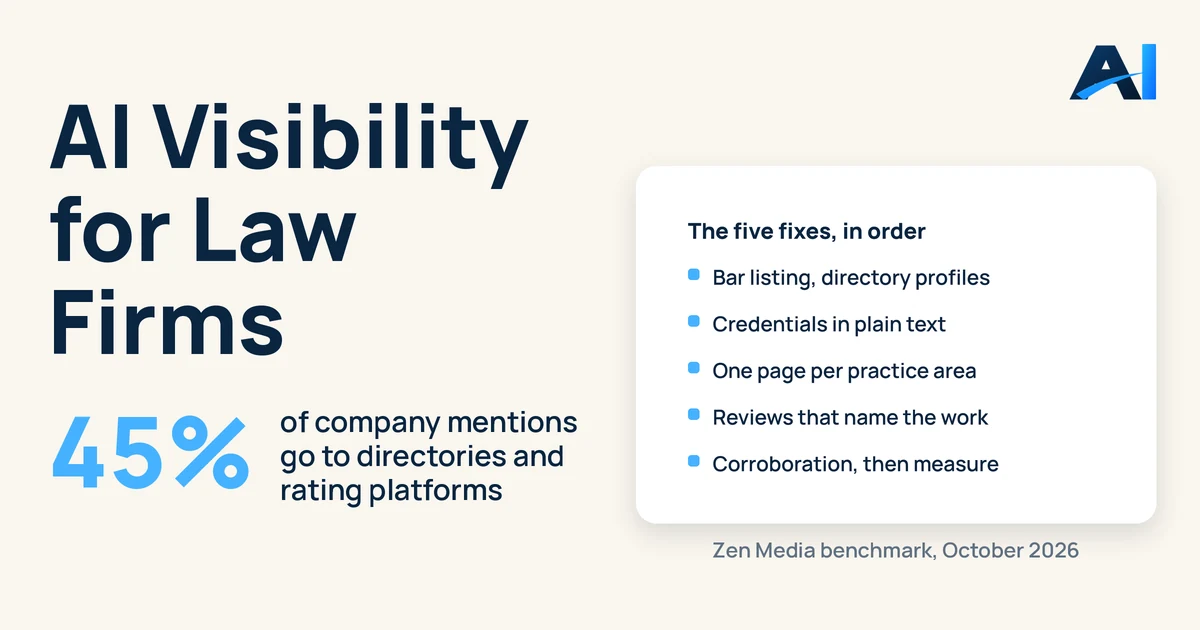
Zen Media's 2026 benchmark of 1,000 legal consumer prompts found no individual law firm among the 20 most named organizations in AI answers; directories and rating platforms took 45 percent of company mentions. This guide covers the order AI reads a law firm in, bar and directory records first, then practice pages, then reviews, and the five fixes in that order.
The short answer
When a prospective client asks ChatGPT, Perplexity, Gemini, or Grok for a lawyer, the answer usually does not name a law firm. It names a directory. In the largest count of this so far, no individual law firm reached the 20 most named organizations at all, and the average firm was named in under 1 percent of answers. That is not because AI cannot find firms. It is because legal hiring is a high trust decision, and AI answers it from the sources built to verify lawyers: state bar listings and attorney directories first, the firm's own pages second, reviews third. A firm gets named by being complete and consistent in that order, not by outwriting the directories.
The questions clients actually ask
Clients rarely ask AI for a firm by name until the very end. They ask while they are still deciding, and Zen Media's prompt data shows how heavily: about 72 percent of the 1,000 legal prompts in its benchmark were comparisons, one option weighed against another. Representative questions from that dataset:
- "How do contingency fees differ between personal injury firms, and what should I look for?"
- "Should I hire a local family law attorney or use an online legal service for my divorce?"
- "How does a board-certified criminal defense attorney compare to a regular criminal lawyer?"
- "How can I verify that an immigration lawyer is legitimate and authorized to practice?"
Read the pattern. Three of the four are really asking whom to trust and how to check. The engine answers by reaching for verification sources, which is why the names it gives back are the verifiers. A firm that only publishes its own claims about itself is asking the engine to skip the step the client explicitly asked for.
Why directories win today
Zen Media's 2026 benchmark, released October 1, 2026, ran 1,000 legal consumer prompts across ChatGPT, Perplexity, Gemini, and Grok and analyzed the 4,000 responses. The headline findings:
No individual law firm appeared among the 20 highest visibility names. The top of the list was Avvo, named in 45 percent of responses, then Martindale-Hubbell at 32 percent, Super Lawyers at 24 percent, FindLaw at 15 percent, and LegalZoom at 13 percent. Grouped by type, legal directories and rating platforms took 45 percent of all company mentions, professional associations and referral services 20 percent, and online legal services 15 percent. There is no law firm category in the split at all.
The sources behind the answers are even more concentrated. Among answers that cited sources, state bar associations were cited in 92 percent, Avvo in 85 percent, Martindale-Hubbell in 78 percent, Super Lawyers in 65 percent, the American Bar Association in 55 percent, and Google Reviews in 45 percent.
What the answers talk about is verification. Credential verification came up in 92 percent of responses, specialization over generalization in 87 percent, and fee transparency in 85 percent. Firm size was treated as a non-factor in 78 percent, free consultations were emphasized in 68 percent, and local knowledge in 62 percent.
Directories win because they publish exactly that evidence in a structured, cross-checkable form: bar admission, practice areas, disciplinary history, peer ratings, and client reviews, all on one page an engine can read and corroborate. A firm's own site usually states the same facts as prose claims nobody else confirms. Facing a consequential question, the engine repeats what it can verify.
One caution before the fix list, because the two kinds of numbers get blurred in most reports. Being named and being cited are different things. 12AM Agency, a law firm marketing agency, separates them plainly: a citation means the engine used your page as a source, a mention means it named you, and a recommendation means it presented you as an option to hire. Taqtics, a personal injury firm marketing agency, reports from its own study of AI legal citations that 67 percent of the time AI names the firm's own site as the source, not a directory. Its homepage publishes no sample behind that figure, so treat it as one agency's count rather than a benchmark. The two findings fit together rather than contradicting: directories win the naming, while a firm's own clear pages still supply much of the underlying evidence. Your site is the citation base. The directories are the door. A firm needs both, in that order of work.
What AI reads for a law firm, in order
First, the state bar listing and the directory profiles. These are the most cited sources in the benchmark, and they are also where a firm's record is most often stale. Avvo builds profiles from bar records whether a lawyer engages or not, so many firms have entries they have never reviewed, carrying old addresses and half their practice areas.
Second, the firm's own practice area pages. This is where specialization, the second strongest theme in the answers, gets proven. One page per practice area, naming the case types handled, the courts and counties covered, and how fees work, in plain words an engine can quote.
Third, reviews. Google Reviews were cited in 45 percent of sourced answers, well behind the bar and the directories. Reviews matter, and reviews that name the practice area and the matter type matter more, but in legal they are the third layer, not the first. This is the reverse of the home services order, where the Google Business Profile and its reviews lead.
The five fixes, in order
1. Fix the bar listing, then claim and complete every directory profile
Start where the citations are. Confirm the state bar listing is accurate for every attorney: name, admission status, practice areas, contact details. Then claim and complete the profiles on Avvo, Martindale-Hubbell, Super Lawyers, FindLaw, and Justia, plus the Google Business Profile. The firm's name, address, phone, website, and practice area list should read identically in every one. An engine cross-checks these records against each other. When the bar listing says one thing and a directory profile says another, the engine trusts neither and names the directory itself instead of the firm inside it.
2. Put the credentials in plain, readable text
Credential verification appeared in 92 percent of the benchmark's answers, the strongest theme measured. So state the proof where a machine can read it, on the attorney bios and the practice pages, in ordinary text rather than in images, PDFs, or badge graphics: bar admissions and jurisdictions, years in practice, board certifications actually held, and disciplinary standing in good standing where that is true. Only publish what is accurate and permitted under your state bar's advertising rules, which limit specialist claims in most states. A certification the firm does not hold, stated to win a mention, is the fastest way to lose the trust this whole exercise runs on.
3. Give each practice area its own page, with fees stated plainly
Specialization beat generalization in 87 percent of answers, and fee transparency appeared in 85 percent. One page per practice area answers both: the case types the firm takes, the process a client can expect, the courts and counties it covers, and how charging works, whether that is contingency terms, a retainer structure, or flat fees where offered, plus whether an initial consultation is free, a point 68 percent of answers raised. Write each page to answer the comparison questions clients actually ask, specialist against generalist, local firm against online service, because about 72 percent of the prompts in the benchmark were comparisons of exactly that kind. A single practice areas page with a bulleted list gives the engine nothing specific to match against any of them.
4. Build reviews that name the work
Reviews are the third layer in legal, not the first, and they still count: Google Reviews were cited in 45 percent of sourced answers. Ask after a matter closes, as a habit, and make it easy for clients to name the practice area and the kind of matter in their own words, within your bar's rules on testimonials and solicitation. A review that says the firm handled a custody modification or a DUI defense tells the next answer what the firm does. "Great lawyer" tells it nothing. Reply to reviews, including the critical ones. Never buy reviews or offer anything in exchange for them.
5. Earn corroboration off your own site, then measure honestly
The benchmark's lesson is that engines repeat what third parties confirm. Commentary in legal and local publications, bar association programs and leadership, and peer recognition are the earned layer that turns a firm's own claims into repeatable facts. Then measure the result the way 12AM Agency prescribes, in four separate lines: whether AI names the firm on a fixed set of client questions, whether those answers send visits, whether the visits become qualified inquiries, and whether the inquiries become retained matters. Their own October 2026 diagnostic shows why the split matters: across 450 tracked questions their headline appearance rate was 9.5 percent, but on the 396 questions that did not already name an agency, the rate was 2.9 percent. Judge your firm on the second kind of number.
Test yourself in five minutes
Open ChatGPT and Perplexity in a private browser window so past conversations do not shape the answers. Ask the questions a client in your practice area asks, with your city: "best [practice area] attorney in [city]," "should I hire a local [practice area] attorney or use an online service," and "how can I verify a [practice area] lawyer is legitimate." Write down every organization named and whether your firm is one of them. Then ask "What can you tell me about [your firm name]?" and check the credentials, practice areas, and contact details in the answer against the truth. Errors almost always trace back to a bar listing or directory profile that was never corrected, which is fix one.
For a scored version across ChatGPT, Perplexity, and Gemini, run the free AI visibility check. Firms that also lose clients at the intake step can pair it with the law firm client intake automation work, and the law firms overview covers how the two fit together.
What not to bother with
Three offers circulate in this market and are worth naming. First, guaranteed placement in AI answers. No engine sells a place in its organic recommendations, and the benchmark shows how concentrated the answer layer is; a firm promising to put you in it on a date is promising something it does not control. Second, a single blended visibility score with no sample behind it. If a report will not split branded questions from open ones, or named from cited, it is measuring the flattering half. Third, review volume as the whole strategy. Reviews are the third source layer for law firms, behind the bar and the directories. A firm with hundreds of reviews and a stale Avvo profile is building on the layer AI reads last for this decision.
If you would rather have it done
The sequence above is the whole job: bar and directory record first, credentials in readable text, one page per practice area with fees in plain language, a review habit, corroboration, and honest re-measurement on fixed questions. Firms that want it worked through in order, with the gaps written up first, can start with the AI Opportunity Audit, which maps what AI says about a firm today and the fixes in priority order.
Questions law firms ask
Why does AI recommend Avvo instead of my firm?
Because Avvo is built to be verified and most firm websites are not. In Zen Media's 2026 benchmark of 4,000 AI responses to legal prompts, Avvo was named in 45 percent of answers and cited in 85 percent of sourced answers, while no individual firm reached the top 20 names. Directories publish bar admission, practice areas, disciplinary history, and reviews in one structured record. The practical response is not to outwrite Avvo. It is to be complete and consistent inside Avvo and the other directories, with your own practice pages supplying the detailed evidence underneath.
Does my firm's own website still matter if directories win?
Yes, as the evidence layer. Taqtics reports from its own study of AI legal citations that 67 percent of the time AI names the firm's own site as the source rather than a directory, and 12AM Agency's distinction explains the apparent conflict: a firm can be cited often and recommended rarely. The website is where specialization, credentials, and fee terms are stated in full. The directories are where those claims get corroborated. Engines need both, and a firm missing either half is easy to pass over.
How should a law firm measure whether this is working?
In four separate lines, per 12AM Agency: how often AI names the firm on a fixed question set, how many visits those answers send, how many of those visits become qualified inquiries, and how many inquiries become retained matters. Keep the question set fixed, split questions that already name your firm from open ones, and re-run monthly. A rise in the first line alone is progress, not proof of new business.
Want a second set of eyes?
We can review where AI may help your business, prioritize realistic opportunities, and decide whether the best first step is an integration, an AI workflow, or custom software.
Book Free AI AuditLooking specifically at ChatGPT and AI discovery? Request a free AI Visibility Checker. You can also see how we improve AI search visibility.
Sources and further reading
The guides combine practical implementation advice with the public references below. Hypothetical examples are labeled and are not customer results.