
AI Search
How Long Does It Take to Show Up in AI Search? The Two Clocks
There is no single timeline, because two clocks are running. Live retrieval can cite a crawled and indexed page within weeks, sometimes days. Model memory, the answers built from training, takes months to name a business and moves only on training cycles. This guide walks through both clocks, the realistic quarter in stages, what speeds each clock up, and the measurement habit that tells an owner whether the work is landing.
The short answer
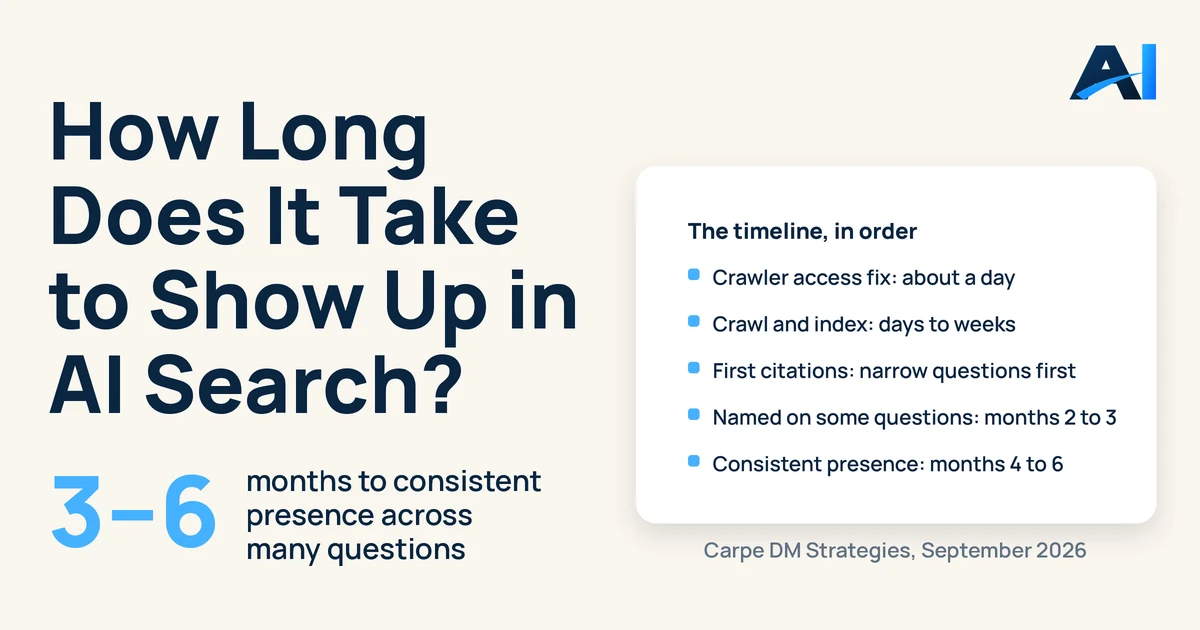
There is no single timeline, because two different clocks are running. The fast clock is live retrieval: when an AI tool searches the web to build its answer, a page that has been crawled and indexed can be cited within weeks, and on some platforms within days. The slow clock is model memory: when an AI tool answers from what it learned in training, without searching, being named takes months, because that memory only changes on training cycles nobody outside the platform controls. Carpe DM Strategies, which published the clearest version of this breakdown in September 2026, puts it in one line: expect crawler activity in days, first citations in weeks, and consistent presence across many questions in three to six months. Anyone who gives you one date for all of it is mixing the two clocks together, usually on purpose.
Clock one: live retrieval
Live retrieval is the path used for current, local, and specific questions, which is most of what a local business cares about. The tool runs searches, reads the top pages, and builds the answer from what it just found, with sources it can show. Your timeline on this clock is really three smaller waits stacked together.
First, access. If a crawler cannot reach your site, nothing else starts. The one precise, platform published number in this whole topic lives here. OpenAI's crawler documentation says it can take about 24 hours from a robots.txt update for its search systems to adjust, and that OAI-SearchBot is the crawler that surfaces sites in ChatGPT search answers. StructFlows, in its small business guide published November 3, 2026, gives the same scale for both OpenAI and Perplexity: crawler access changes take about a day to register. Fixing a block is a one day wait. It is also the only one day wait you will find in this article.
Second, crawl and index. A new or fixed page has to be fetched and stored before any answer can use it. Google is unusually honest about how wide this range is. Its AI features guide says a page must be indexed and eligible to be shown in Google Search with a snippet to appear as a supporting link in AI Overviews or AI Mode, with no additional technical requirements, and its troubleshooting notes say crawling can take anywhere from several days to several months, depending on how often its systems decide a page needs refreshing. Cited, in its June 2026 guide, puts the working ranges most owners will see: indexing within hours to days on an established site after a sitemap submission to Search Console, and one to two weeks for Bing Webmaster Tools. A new site waits longer than an established one at this step, and that difference explains a lot of the disagreement between the guides quoted in this article.
Third, being picked. Indexed is not the same as cited. The page still has to be chosen for a specific answer, ahead of the other pages that answer the same question. This is where the published ranges spread out:
- Perplexity moves fastest in most accounts. Cited puts new content cited in Perplexity at 1 to 4 weeks after the PerplexityBot crawl. Lemniscate Growth, in its September 2026 indexing speed breakdown, puts it faster on well crawled domains, commonly quotable within 24 to 72 hours, and is explicit that on newer or thinly linked domains one to three weeks is the more realistic expectation.
- ChatGPT search sits close behind. Lemniscate puts the common window at one to seven days for a new URL on a maintained site, with heavily linked content moving faster.
- Google's AI features are slower to show a new page, because the page must first earn its place in the regular index. Cited puts Google AI Overview inclusion at 4 to 8 weeks after structural improvements for existing pages, and 8 to 12 weeks for new content.
Read those as ranges from practitioner guides, not as platform promises. Google and OpenAI publish eligibility rules and the roughly 24 hour crawler setting. They do not publish a citation date, and the gap between the fastest and slowest guide above is mostly a gap in starting position: an established, frequently crawled site versus a new one.
Clock two: model memory
The second clock explains the experience almost every owner reports: one AI tool cites a page you published last month, and another still describes your business from years ago, or does not know it at all. When an answer shows no sources, it was built from training, and training has a cutoff. A business that was written about widely and consistently before that cutoff is easy for the model to recall. A business that fixed its record last month is not in that memory yet, no matter how good the fix is.
Lemniscate puts the planning lag for this clock at three to nine months, because today's content can only shape an answer given without searching after it has been absorbed into a training or reinforcement cycle. Carpe DM makes the same point in plainer words: model memory is the durable kind of visibility, it cannot be rushed, and the practical move is to aim early work at live retrieval while the slow clock runs in the background.
Two consequences follow. First, no technical fix on your own site speeds this clock up. Sitemaps, submissions, and page edits move clock one. Second, the work that does move clock two is the slow, off site kind: third party coverage, directory and review platform presence, community discussion, and the same business facts stated the same way in all of those places, accumulated over months. That is not a reason to skip it. It is a reason to start it early, because it pays late.
A page being cited is not the same as your business being named
Most timeline guides measure a publisher's problem: how fast a new article gets cited. A local business has a second, slower problem layered on top: getting named as the recommendation, not just linked as a source. Being cited means your page helped build an answer. Being named means the answer tells the customer to call you. The second one needs the listings, reviews, and mentions to agree with the page, and those inputs move at their own speeds. A directory can take weeks to update its record. Reviews accumulate one finished job at a time.
That is why the most local timeline on the first page is also the longest. OpGo Marketing, a local agency writing for local clients, lays its version out plainly: months 1 to 3 are foundation building, claiming and completing listings, cleaning up inconsistent information, and starting to ask for reviews, with likely little visible movement. Months 3 to 6 are where things start to show up, as the new records get indexed and the business begins appearing for a handful of specific, less competitive questions. Months 6 to 12 are where consistent effort compounds into the most noticeable shift in how often the business shows up. Set that beside Carpe DM's three to six months for consistent presence and the roundup in Grid13's October 2026 piece, which reports initial signals in 4 to 8 weeks from both WebFX and The Answer Engine and consistent citations in 3 to 6 months, and the honest summary for a local owner is this: first signs in weeks on the fast clock, a pattern you can trust somewhere in the three to six month range, and the full local shift can take longer.
What a realistic quarter looks like
Weeks 1 to 2. Access fixed, and the first real signal appears where only you can see it: AI crawler hits in your server logs, returning your pages successfully. Carpe DM calls this the earliest real signal, because it confirms the door is open. Nothing a customer can see has changed yet, and judging the work now judges it before it started.
Weeks 2 to 6. New and fixed pages get indexed. The retrieval first tools, Perplexity above all in the guides above, are usually the first to cite you, and the first citation normally lands on your narrowest, most specific question, not your biggest one. A plumber cited for a specific service in a specific town is what early progress actually looks like.
Months 2 to 3. Citations spread across more questions as more pages accumulate. Grid13's reported 4 to 8 week window for initial signals belongs in this stretch. Listings corrections made in month 1 have been reindexed, reviews written in that period are part of the record, and assistants begin naming the business on some questions rather than only linking its pages.
Months 4 to 6. This is where the guides converge: consistent presence across most of your buyer questions, if the work stayed consistent. It is also the first point where a judgement is fair. Anything concluded before this stretch was concluded on the fast clock alone.
What speeds each clock up, and what slows it down
Starting position is the biggest factor. A site already indexed and regularly crawled moves faster at every step than a new domain, because retrieval already has something to work with. This is the main reason two businesses can do the same work and see it land months apart.
An access block, once fixed, can produce a step change. If crawlers were blocked, the content was always there. Unblocking it is the one fix that can move the fast clock quickly, after the roughly one day adjustment OpenAI documents.
Specific questions move before broad ones. A narrow question has a short list of good answers, so a clear new page can enter it quickly. The broad category question in a competitive field is the slowest possible starting point. Grid13, reporting Passionfruit's ranges, puts open niches at weeks to 2 to 3 months and saturated fields such as insurance, real estate, and finance at 6 to 12 months and more. Local service questions sit between those poles, closer to the open end when the town and the trade are specific.
Consistency beats bursts. Carpe DM's version is that a steady rate of genuinely useful pages compounds, and ten pages in one week followed by four months of silence does not. The same applies to reviews and listings work: a habit produces a record, a campaign produces a spike and then a stale one.
Corroboration is the slowest input and the highest ceiling. Outside mentions are the input clock two runs on. They take the longest to earn and the longest to register, which is exactly why they belong at the start of the work, not the end.
What slows everything down is usually mundane: listings left incomplete or contradicting each other, pages too generic to quote for any specific question, and treating the whole thing as a one time project. OpGo names that last one directly. A record that stops being maintained starts ageing out of the answers built from fresh retrieval.
How to judge movement honestly
The measurement habit matters as much as the timeline, because AI answers vary between runs. A single check, on a single day, in a single tool, proves almost nothing in either direction. Carpe DM's warning is the one to take seriously: the mistake that wastes the most time is judging it too early, on the wrong question, checking the biggest and most competitive question in the category during week two, seeing a competitor, and concluding it does not work.
Judge it this way instead:
- Fix the questions. Pick the buyer questions that matter, including at least two narrow ones (a specific service, in your town), and write them down before you change anything. Movement shows up on the narrow questions first.
- Run them on a schedule, not on impulse. Monthly is enough. Run each question more than once, ideally in a fresh chat, and record named, cited, or absent for each business, yours and the competitors who keep appearing. The full method is in how to test your visibility in ChatGPT and AI search.
- Watch the early signals between checks. Crawler hits in your logs, new pages showing as indexed, and impressions growing in Search Console all move before citations do. They tell you which stage is slow: no crawler hits is an access problem, indexed but never cited is a page problem, cited but never named is a listings and mentions problem.
- Judge over a quarter. Ten readings over ten weeks, in Carpe DM's phrasing, tell you whether you are climbing. One reading tells you what one answer said once.
For a scored starting point across ChatGPT, Perplexity, and Gemini, run the free AI visibility check. It gives you the baseline the monthly checks are then measured against. The guide to getting cited by Perplexity covers the fastest clock in detail, which is useful for morale as well as method: it is the surface where honest work tends to show first.
What anyone promising a date is really selling
No platform in this article publishes a date by which a fixed page will be cited or a business will be recommended. Google publishes an eligibility rule and a crawling range of several days to several months. OpenAI publishes a crawler rule and a roughly 24 hour adjustment. Everything tighter than that is a practitioner estimate, including the useful ranges quoted above, and estimates move with starting position, competition, and how much of the record needs fixing.
So a firm that promises to have you recommended by a specific date is selling one of three things: a paid ad, which is labelled, sits separate from the answer, and does not influence it; a guess dressed as a schedule; or work on the fast clock reported as if it were the slow one, a citation in one tool in week two presented as being recommended everywhere. The honest version of the offer is a sequence and a measurement habit: access and pages first, listings and mentions started early because they pay late, the same questions rerun monthly, and a judgement made over a quarter. Owners who want that sequence worked through for their business, with the current standing written up first, can start with the AI Opportunity Audit.
Questions owners ask
What is the first sign it is working?
AI crawler hits in your server logs, with your pages returned successfully. That is the signal Carpe DM puts first, and it comes before anything a customer can see. After that, in order: pages indexed, a first citation on a narrow question (usually in Perplexity first, per the ranges above), then being named, then being named consistently. If you are watching for the last step while the first one has not happened, you are watching the wrong clock.
Why is Perplexity showing my new page but ChatGPT is not?
Because they lean on the clocks differently. Perplexity leans hardest on live retrieval, so it reflects new content fastest, which is why both Cited and Lemniscate give it the shortest ranges. ChatGPT blends live search with model memory, so a new page can be reachable by its search path while the business behind it is still described from older training. That gap is normal, it is measured in weeks to months, and it closes as the retrieved record and the remembered record converge.
Can I make it happen faster by publishing a lot at once?
Not in the way the promise usually means. Publishing more genuinely useful pages gives retrieval more to choose from, and a burst does no harm by itself. But the slow inputs do not compress: listings take their own time to update and reindex, reviews arrive at the speed of finished jobs, mentions are earned at other people's pace, and model memory runs on training cycles. A burst followed by silence also leaves a record that ages. The guides agree on the alternative: steady, specific, and maintained beats large and occasional, and the quarter is still the honest judging window.
Want a second set of eyes?
We can review where AI may help your business, prioritize realistic opportunities, and decide whether the best first step is an integration, an AI workflow, or custom software.
Book Free AI AuditLooking specifically at ChatGPT and AI discovery? Request a free AI Visibility Checker. You can also see how we improve AI search visibility.
Sources and further reading
The guides combine practical implementation advice with the public references below. Hypothetical examples are labeled and are not customer results.