
AI Search
AI Visibility for Insurance Agencies: How to Be the Agency AI Recommends
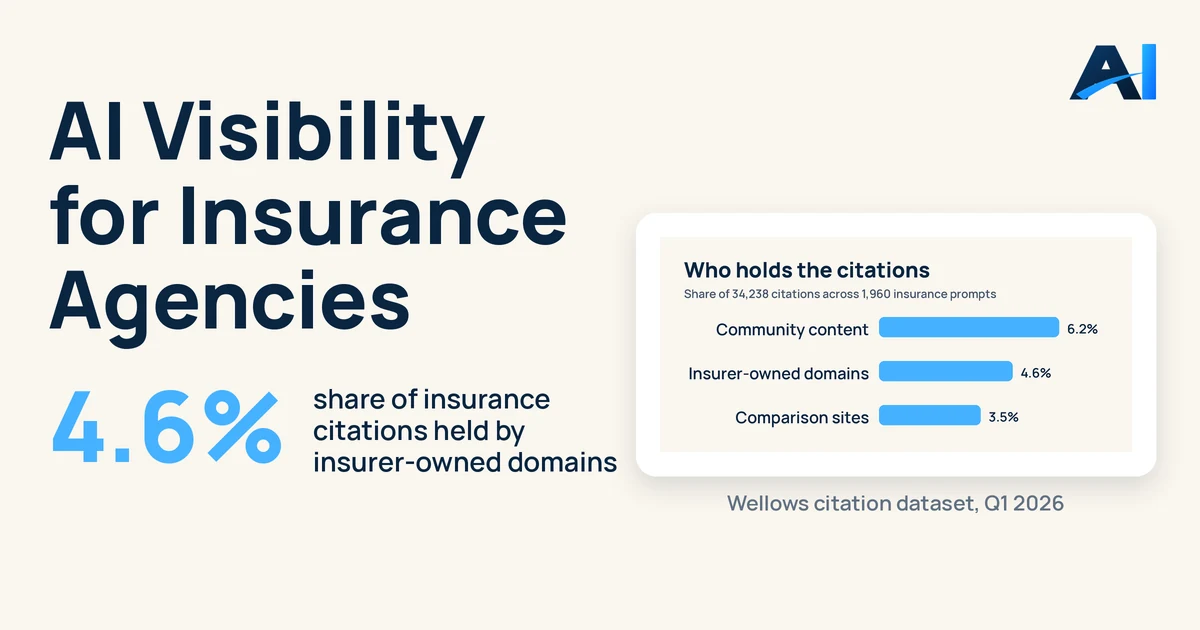
Wellows' first quarter 2026 citation dataset (1,960 insurance prompts, 34,238 citations) puts insurer-owned domains at just 4.6 percent of the citations in their own category's answers, and GEO Extension's insurance guide names the winnable layer underneath the generic question: the prompts with a complication in them. This guide covers both, the order AI reads an agency in, and the five fixes in that order.
The short answer
Insurance is the trade where the category's own brands are most absent from their own answers. Wellows, which tracks AI citations, analyzed 1,960 insurance prompts that produced 34,238 citations in the first quarter of 2026, and insurer-owned domains captured only 4.6 percent of them. Comparison sites took 3.5 percent, and community content, led by Reddit as the single most cited domain, took 6.2 percent. When an assistant answers an insurance question, it is mostly reading third parties, not carriers and not agencies. The generic question, "best car insurance," belongs to the carriers and to comparison editorial like NerdWallet and Bankrate, and no local agency takes that slot head-on. The openings are underneath it: the questions with a complication in them, an SR-22 filing, a house in a flood zone, a short-term rental, a new business that needed liability coverage yesterday. Those buyers are not shopping for a carrier. They want a person who can navigate carriers, and assistants name agencies when the published record documents exactly that skill: the lines you are licensed for, the carriers you represent, and reviews that describe help when a claim went wrong.
Three splits decide which answers you can win
Insurance questions divide three ways at once, and each split changes what the assistant reads.
By line. Auto, home, commercial, and life questions draw on different sources and different competitors. An agency strong in home and auto answers is not automatically present in commercial answers.
By channel. Independent agencies, captive agencies tied to one carrier, and direct writers are three different offers. The independent's whole case, one agent who shops several carriers, only reaches an answer if it is written down somewhere the assistant can read.
By moment. Most insurance questions arrive at a moment: a car bought, a business starting, a claim denied or slow, a renewal that jumped. Found in AI, which tracks these questions for agencies, builds its question set on exactly those moments, because that is when a buyer asks an assistant instead of waiting for a referral.
The questions buyers actually ask
Written the way buyers write them, the questions an independent agency can actually win look like this:
- "Best independent insurance agent near me who can shop my home and auto with several carriers"
- "I need an SR-22 filed fast in [state]. Who can do it?"
- "Who insures a house in a flood zone in [city]?"
- "Can an agent insure my short-term rental, and what does it need?"
- "My business needs general liability coverage this week. Who should I call in [city]?"
- "My renewal jumped 30 percent. Should I switch, and who can re-shop it?"
- "Insurance agencies to avoid in [city], and who handles claims well instead"
Two things to notice. First, the shortlist is short: Insurance Marketing Co, which runs its own lead book and tests these questions on itself, describes ChatGPT returning two or three names with a one-line reason each, so fourth is the same as absent. Second, almost half the questions in Wellows' dataset were not buying questions at all: informational intent was 46 percent of prompts, commercial 27 percent, and about 9 percent were explicit "does insurance cover X" questions. For the coverage questions, assistants cite condition and product authorities, not insurers. One health and sleep site was the second most cited domain in the whole dataset, ahead of every carrier. An agency does not win those citations with sales pages. It wins a share of them with plain, accurate coverage explainers written for its own state and lines.
Why the carriers and the comparison sites win today
They publish the layer assistants read. Carrier brands carry the name recognition, and NerdWallet and Bankrate publish the cost explainers and carrier reviews that assistants pair with their answers. GEO Extension's insurance guide makes the mechanism plain: ask for the best car insurance and you get carrier brands filtered through that editorial, an answer no local agency cracks head-on. The same guide names the layer underneath as the winnable one, the prompts with a complication, where the buyer wants a human who can navigate carriers and the assistant names agencies whose evidence documents that navigation.
Buyers are already asking. Invoca's 2026 Insurance Buyer Experience Report, reported in Freedom Marketing Group's November 2026 review of the research, found 63 percent of its surveyed US insurance consumers had used a generative AI tool to research a high-stakes purchase, up from 49 percent the year before. That survey was small, 129 consumers, so treat the direction as the finding, not the exact figure: the asking has moved into the assistant, and the shortlist forms before any agent hears about it.
There is one more insurance specific wrinkle. Advertising in this trade is state regulated, a point Wellows' playbook leads with: when an assistant surfaces an inaccurate coverage or pricing claim about your agency, that is regulatory exposure, not just a bad look. Accuracy about your own lines, carriers, and licensing is not housekeeping here. It is the deliverable the assistant repeats.
What AI reads for an agency, in order
First, the Google Business Profile. Across all local trades, BrightLocal's August 2026 analysis found the profile was cited for 94.17 percent of the businesses checked and took 28.63 percent of all citations. For an agency the profile has to carry the lines you write and the areas you serve, in the categories and services, not just the agency name and a pin.
Second, reviews that describe claims help. Yelp was a source in 80 percent of ChatGPT's local answers in BrightLocal's count, and GEO Extension's source table notes assistants pull Yelp quotes about claim handling and responsiveness, the two qualities carrier editorial cannot speak to. WordOfGPT's insurance guide makes the same point as a fix: reviews describing help during a claim are the most persuasive record an agency owns, because the moment buyers most want an agent is the moment something went wrong. A page of five star reviews that only say "great rates" gives the assistant nothing to quote for that question.
Third, the verification directories. This layer is insurance specific. Trusted Choice, the independent agent directory, is the list assistants can cite by name when a question asks for someone who can shop multiple carriers. Carrier directories matter the same way: WordOfGPT notes carrier directories are cited for local agents, so a stale listing there is a missed citation, not a clerical detail. And behind both sits the state insurance department's license lookup, the regulator's record that the agency and its producers are licensed, which GEO Extension describes assistants using to verify before repeating a recommendation. If your licensing facts are hard to verify, you are easy to skip.
Fourth, your own website, which has to state the complicated thing. About 93 percent of the domains cited in BrightLocal's research were individual business websites, so your pages are read. The ones that get quoted are the ones that document the navigation skill: the lines you are licensed for, the carriers you represent, how claims support works at your agency, and which kinds of businesses you cover, such as contractors or restaurants. Found in AI's tracking page lists the same four facts as what gets an agency described. The complicated cases you handle sit on top of those four: SR-22 filings, flood zone homes, short-term rentals, high risk drivers, new businesses. A services page that says "all your insurance needs" documents none of them.
The five fixes, in order
1. Write down the complicated cases you handle
One page, or a clear section per case, for each complication you genuinely handle: SR-22 filings, flood zone and coastal homes, short-term rentals, high risk drivers, new business liability, contractors and restaurants if you write them. State the case, what makes it hard, and how you place it, in plain sentences an assistant can lift. This is the winnable layer, and it only works for cases you actually take. Do not list a case to win the question if the office turns that caller away.
2. Publish the verification record in one consistent form
Your licensed lines, the states you are licensed in, the carriers you represent, and how a buyer reaches a licensed agent, stated the same way on your site, your Google Business Profile, Trusted Choice, your carrier directory listings, and your BBB and Yelp records. Assistants reconcile these records before naming anyone, and in this trade they can check the state license lookup behind them. Where the records disagree about your lines or carriers, the assistant has nothing stable to state, so it names the agency whose record agrees with itself.
3. Give each line its own page
Auto, home, commercial, and life are different questions with different sources, so one blended services page answers none of them cleanly. One page per line you write, stating who it is for, the complications you see in that line, and the carriers you place it with. Keep coverage explanations educational and accurate for your state, and resist quoting prices you cannot stand behind: in a regulated trade, a specific price an assistant repeats wrong is your problem, not the assistant's.
4. Build the claims help review record
Ask for reviews at the moment the value is felt, which in insurance is usually after a claim was handled well, a renewal was re-shopped down, or a hard case got placed. Ask what happened and how the agency handled it, in the client's own words, and never offer anything in exchange. Reply to the critical reviews with what changed. The "agencies to avoid" question reads the critical record and the replies, and an agency with answered complaints reads very differently from one with silence.
5. Answer the agent versus direct question honestly
A share of buyers ask the assistant whether they should use an agent at all or buy direct. WordOfGPT's guide puts answering that question honestly first among its fixes, including when direct is fine, because assistants reward the source that explains the trade-off over the source that only sells. One straight page, what an independent agent does at quote time and at claim time, what it costs (explain how you are paid, in plain terms), and when buying direct is the reasonable choice, gives the assistant a quotable answer with your name on it.
Test yourself in five minutes
Ask ChatGPT and Google AI Mode the same three questions: "best independent insurance agent near me who can shop home and auto," the complication question that fits your book, for example "who can file an SR-22 fast in [your state]" or "who insures short-term rentals in [your city]," and "insurance agencies to avoid in [your city]." Run each question three times on each engine, because answers move run to run, and a single check is an anecdote. Write down every agency named, where you appear if you appear, and every source cited, especially whether Trusted Choice, a carrier directory, or a review platform carried the answer. Then check your own record the way the assistant does: your lines and carriers, stated identically in the five places above.
For a scored version across ChatGPT, Perplexity, and Gemini, run the free AI visibility check. The insurance agencies overview covers how that check and the follow-on work fit together for an agency.
What not to bother with
Three traps recur in this trade. First, chasing the generic carrier questions. "Best car insurance" is carrier and comparison editorial territory, settled by brands with national pages; an independent agency's hours go further on the complication questions where a person, not a carrier, is the answer. Second, buying visibility in the coverage explainer layer with thin content. Almost half the prompts in the dataset were informational, but assistants filled them from authorities they already trust, and a batch of generic "does insurance cover X" posts from an agency site is competing inside the owned layer that held just 4.6 percent of citations across the whole category. Write the few explainers your own clients actually ask about, accurately, and stop there. Third, treating your website as the record. Insurer-owned domains held 4.6 percent of citations in Wellows' count, and agency sites live in that same owned layer. The directories, reviews, and license record are not support for the website. In this trade they are the evidence, and the website is where the evidence gets explained.
If you would rather have it done
Agencies that want it worked through in order, with the gaps written up first, can start with the AI Opportunity Audit, which maps what AI says about a company today and the fixes in priority order.
Questions insurance agencies ask
Why does the assistant name carriers and comparison sites instead of my agency?
Because on the generic questions, those are the sources it reads. In Wellows' first quarter 2026 dataset of 34,238 insurance citations, insurer-owned domains held 4.6 percent and comparison sites 3.5 percent, while community content alone held 6.2 percent. The assistant builds the answer from third parties, and on a broad question the third parties with the deepest coverage are carrier editorial and comparison sites. Agencies get named on the narrower questions, the complicated cases and the local trust questions, where a carrier page is not an answer.
Do I need to be on Trusted Choice and the carrier directories?
They are the closest thing this trade has to a citation shortcut. Trusted Choice is the independent agent directory assistants cite by name for multi-carrier questions, and carrier directories are cited for local agents, so a missing or stale listing removes you from answers your own site cannot enter. They do not replace your own pages, but in a trade where the assistant verifies before it recommends, they are part of the verification.
How long does it take for an agency to start showing up in AI answers?
There is no fixed timeline, and the honest test is repetition, not a date. Fix the verifiable record first, lines, carriers, licensing, and directory listings in one consistent form, publish the complicated cases you handle, and then re-run the same fixed set of questions monthly and count how often you are named across runs. An agency that appears in one run and vanishes in the next has a consistency problem to fix, not a waiting problem.
Want a second set of eyes?
We can review where AI may help your business, prioritize realistic opportunities, and decide whether the best first step is an integration, an AI workflow, or custom software.
Book Free AI AuditLooking specifically at ChatGPT and AI discovery? Request a free AI Visibility Checker. You can also see how we improve AI search visibility.
Sources and further reading
The guides combine practical implementation advice with the public references below. Hypothetical examples are labeled and are not customer results.
- Wellows: AI Visibility Solutions for Insurance Marketing Agencies (citation dataset, first quarter 2026)
- GEO Extension: GEO for Insurance Agencies (updated July 2026)
- WordOfGPT: 6 Ways Insurance Agencies & Brokers Get Recommended by AI
- Found in AI: AI Visibility Tracking for Insurance Agencies
- Freedom Marketing Group: AI in Insurance Lead Generation (November 2026), reporting Invoca and Conductor
- BrightLocal: Where to Get Local Citations for AI Search (August 2026)