
AI Search
AI Visibility for Dental Practices: How to Be the Practice AI Recommends
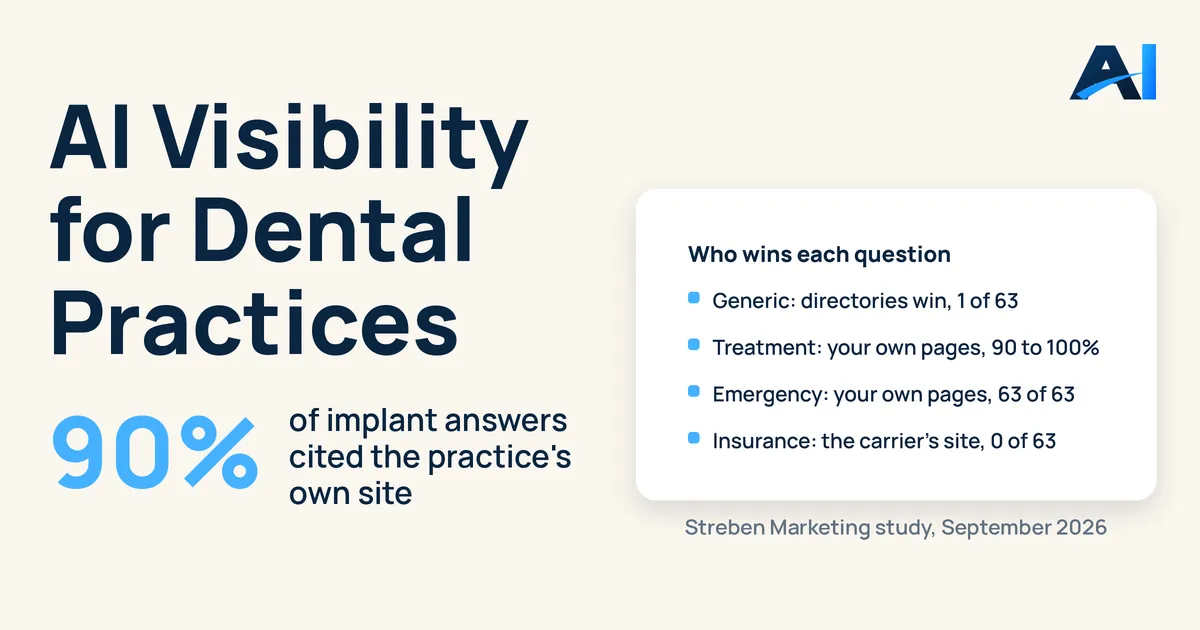
Streben Marketing's September 2026 study, 546 ChatGPT responses across 12 US markets, found that who wins an AI dental answer depends on the kind of question: directories take the generic question, the practice's own pages take treatment and emergency questions, and the carrier's site takes insurance questions. This guide covers the four tiers, the order AI reads a dental practice in, and the five fixes in that order.
The short answer
Dental is not one AI contest. It is four, and each one is won in a different place. When a patient asks for the best dentist in town, AI answers from directories and review sites, and a practice's own website is almost never the source. When the question names a treatment, an implant, a full arch case, or a cracked tooth at 8pm, the answer flips: the practice's own pages become the source in 90 to 100 percent of answers in the one dental specific study that has measured this. When the question is about insurance, the carrier's own find a dentist tool answers it and practice websites score zero in large cities. So a practice gets recommended by working the tiers in that order: build the treatment and emergency pages only it can win, publish the prices and plans patients ask about, fix the carrier and directory records, and keep the review volume that gates the generic question.
The questions patients actually ask
Patients ask AI the way they would ask a trusted friend, with the constraint included. Grouped by what the engine does with each kind:
- "Best dentist in [city]" (the generic question)
- "Dental implants in [city]" and "All-on-4 full arch implants in [city]" (the treatment questions)
- "Emergency dentist for a cracked tooth in [city]" (the urgency question)
- "Dentist that takes Delta Dental in [city]" (the insurance question)
The demand behind these is real and growing. In rater8's 2026 Patient Choice Report, a survey of nearly 1,000 US patients published in April 2026, 47 percent said they had used AI to research a provider, up from 31 percent nine months earlier. Dentistry also carries an urgency load most trades do not: the American Dental Association counts roughly 2 million US emergency department visits a year for dental pain, most of which could be handled in a dental office. The person asking the emergency question is not browsing. They are asking once and calling the first credible answer.
Why directories win the generic question
Two independent counts agree on the generic tier.
5W Research's Dental AI Visibility Report, published in May 2026, found that answers to consumer dental questions come from a tight set of nine directory and review properties: Google Business Profile, Healthgrades, Zocdoc, Yelp, Vitals, WebMD, ADA Find-a-Dentist, 1-800-DENTIST, and RateMDs. Individual practices, even the largest dental groups in the country, appear inside those directories but rarely as independent voices, and 5W found zero dental specialty editorial sources in the top citations for any consumer query it tested.
Streben Marketing's September 2026 study measured the same tier directly. It ran ChatGPT 546 times across 12 US markets and five question types, seven runs of each question in each market, and separated the businesses an answer named from the pages it cited as sources. On "best dentist in [city]," ChatGPT cited a practice's own website in 1 of 63 runs. The cited sources were directories 87 percent of the time, led by Healthgrades, WebMD Care, hosted review pages, and city magazine "Top Dentists" lists. That does not mean practices were absent from those answers: ChatGPT still named practices in 62 of 63 runs, about 12 per answer on average. But 28 different practices took the top named spot across the 63 runs, which makes the top of the generic answer close to a coin flip from one run to the next.
Being named and being cited are different games, and the study's chain example shows the split cleanly. One national full arch implant brand was named in 174 of the 546 answers and had its own site cited as the source in 11. Brand recognition buys the mention. Specific published pages buy the citation. The most cited practice domain in the whole study was a national group that publishes a real, distinct page for each city and each service, cited in 25 of the 63 implant runs and 27 of the 63 emergency runs.
Where the answer flips: treatment, emergency, and insurance
The same Streben study is the useful one because it measured the other tiers with the same method:
Treatment questions are website owned. On "dental implants in [city]," a practice's own site was cited in 90 percent of runs (57 of 63), and practice sites made up 87 percent of all cited sources. On the full arch specialty question, practice sites were cited in 100 percent of runs and made up 97 percent of sources. The directories that hold the generic tier nearly disappear once the question names a procedure.
The emergency question is the clearest opening in the trade. On "emergency dentist for a cracked tooth in [city]," a practice's own website was cited in 63 of 63 runs, practice sites made up 97 percent of cited sources, and no directory was cited in any national run, including the emergency dentist lead generation sites that dominate paid search for that phrase. The reason is mechanical: the answer needs hours, a walk-in policy, and whether someone can be seen today, and those facts exist only on practice websites. Streben's finding is that almost nobody has built a real page for this question.
The insurance question is a shutout, with one exception. On "dentist that takes Delta Dental in [city]," a practice website was cited in 0 of 63 runs in the nine large metros. Every cited source was a payer property, and the carrier's own site appeared in 62 of 63 runs. The model finds the carrier's find a dentist tool and stops. In the three smaller towns in the study the pattern broke: practice sites were cited in 10 of 21 insurance runs (48 percent), because where a carrier directory returns only a handful of local providers, the model keeps looking and finds practice pages that state accepted plans in plain text.
One more measured detail matters for how pages get written. Adding the word "best" to a treatment question cut the practice site citation rate sharply in Streben's controlled test: "dental implants in [city]" fell from 95 percent on the descriptive wording to 62 percent with "best" added, and the full arch question fell from 100 to 86 percent. A superlative is a request for a ranking, and ranking requests get answered from ranking sources. Write page headings descriptively, the way the treatment question is asked without "best" in it.
What AI reads for a dental practice, in order
First, the carrier and directory records, for the two tiers your site cannot win. The insurance answer is read off the carrier's provider record, and the generic answer is read off the nine directories. Those records are the practice's entry ticket to both.
Second, the Google Business Profile and the review record, which gate the generic tier. Across all local trades, BrightLocal's August 2026 analysis of nearly 2 million AI citations found the Google Business Profile was the largest single directory source, cited for 94.17 percent of the businesses checked (that figure is all trades, not dental alone). Inside the generic tier, Streben found reviews work as a filter rather than a ranking signal: the businesses the assistants recommend average 4.3 stars on ChatGPT, 4.1 on Perplexity, and 3.9 on Gemini in the 350,000 location study it cites, so the rating clears a bar and volume and recency do the rest.
Third, your own treatment and emergency pages, which decide the tiers worth the most. Implants, full arch, and emergency care are the highest value questions a practice can be asked.
Fourth, your published facts: prices, financing, accepted plans, hours. On the tiers where a practice's site is cited, Streben watched ChatGPT build its implant cost answers directly out of the handful of practices in each city that publish price ranges on their own pages, quoting those practices by name. Every other practice was named with no part in the number the patient was shown. Whoever publishes the number becomes the source of the number.
The five fixes, in order
1. Build the emergency page first, then one page per money treatment
Start where the citation rate is 100 percent and the competition has not shown up. The emergency page states, in plain text: your hours, your walk-in and same day policy stated honestly, what to do for a cracked tooth or a knocked out tooth, and how to reach the practice after hours. Then give each significant treatment its own specific page: implants, full arch where the practice offers it, sedation, root canal, Invisalign or clear aligners, cosmetic work, each written descriptively rather than as a "best" page, saying which stages the practice performs in house, who provides the treatment, and where consultations happen. Check once, and again after any host or security change, that the AI search crawlers (OAI-SearchBot, Claude-SearchBot, PerplexityBot) are not blocked from the site: a blocked crawler fails silently and appears nowhere in analytics, and a page the crawler cannot fetch cannot be cited.
2. Publish your price ranges, financing, and accepted plans in plain text
AI fills a missing fact from wherever it can, and the cost guides it falls back on disagree with each other by a factor of two or more in Streben's checking. Publish real ranges for the treatments patients price shop, what a consultation costs or whether it is free, what a quoted figure includes and what it does not, and the financing options offered. State accepted insurance plans as readable page text, not only inside a logo strip or a form. In a large metro this page will rarely be the cited source for an insurance question. In a smaller market, Streben's data says it wins about half the runs, which makes it one of the highest return pages a small town practice can publish.
3. Fix the insurance records as an operations job, not a marketing job
For the insurance tier there is no listicle to outrank and no review score to raise. The levers are being in the networks the practice claims to be in, and having each carrier's provider record current: address, phone, and whether the practice is accepting new patients. A stale record in a carrier directory is the record the AI reads, and no website copy fixes it. Run the same accuracy pass over the directory profiles that hold the generic tier: Healthgrades, WebMD Care, Zocdoc, Vitals, RateMDs, Yelp, and the ADA Find-a-Dentist listing, with the practice name, address, phone, services, and dentists reading identically in each.
4. Complete the Google Business Profile and keep it current
The profile is the structured record AI reads first for a local practice, and the anchor of the nine directories in the 5W count. Fill in every field: the right primary category, each treatment as its own service entry, hours including holiday hours, photos of the actual office and team, and a booking route that works. Photo count deserves a specific mention in dental: in the Uberall analysis covered below, photo count was the only measured signal that predicted both whether a dental practice was mentioned and how often. Keep the facts moving: a profile whose hours and services are current is evidence the practice is active, and stale facts get repeated by AI with the same confidence as true ones.
5. Build review volume that names the treatment
Here is the dental specific benchmark, with its caveat stated plainly. Uberall's analysis of more than 120,000 AI mentions across 3,793 US locations, reported in a sponsored Search Engine Journal article on September 10, 2026, found that for dentists no star rating on any measured platform reached statistical significance, while volume did: mentioned dental practices averaged 643 Google reviews against 253 for practices that were not mentioned, and practices with more than 1,000 reviews were mentioned at a reported 92.9 percent rate. Uberall sells local visibility software and has not published its full dataset or prompt set, so read those numbers as a vendor benchmark showing the shape, volume over rating, not as a target to hit. The working habit is the same one every trade guide in this series lands on: ask after completed treatment, as a routine rather than a campaign, and make it easy for patients to name the treatment, the dentist, and the experience in their own words, without ever confirming patient details in a reply. A review that says the practice handled an implant or calmed an anxious patient tells the next answer what the practice does. Reply to reviews, including the critical ones. Never buy reviews or offer anything in exchange for them.
Test yourself in five minutes
Ask one question from each tier, in a private browser window so past conversations do not shape the answers: "best dentist in [your city]," "dental implants in [your city]," "emergency dentist for a cracked tooth in [your city]," and "dentist that takes [your main plan] in [your city]." Write down every practice named and every source cited, and whether yours appears as a name, as a source, or not at all. Then ask "What can you tell me about [your practice name]?" and check the treatments, plans, hours, and prices in the answer against the truth. One warning from the measurement research: a single run is close to noise. In Streben's generic tier, 28 different practices took the top spot across 63 runs of the same question, and its method ran every question seven times for that reason. Judge movement on repeated runs of the same fixed questions, monthly, not on one screenshot.
For a scored version across ChatGPT, Perplexity, and Gemini, run the free AI visibility check. The dental practices overview covers how that check and the follow-on work fit together for a practice.
What not to bother with
Three offers circulate in this market and are worth naming. First, guaranteed placement in AI answers. In Streben's 546 answers, no advertiser had bought a placement inside any of them; the directories holding the generic tier have not started buying their way into the answer itself. Treat that as a window, not a permanent condition, and treat anyone selling a guaranteed place in it as selling something they do not control. Second, the claim that adding FAQ or structured question and answer content raises AI citation by 37 to 40 percent. Streben traced that figure through the research literature and found it fabricated: the numbers belong to a different tactic in the Princeton GEO paper, which never tested FAQ formatting at all, and the paper's own headline figure measured a source's share of an answer it was already in, not an increase in being found. FAQ sections help a reader; do not buy them as a citation trick. Third, paying booking marketplaces per new patient as the whole visibility strategy. Those fees buy the generic tier one patient at a time. The treatment, specialty, and emergency tiers can be owned outright with pages, for the cost of writing them once.
If you would rather have it done
The sequence above is the whole job. Practices that want it worked through in order, with the gaps written up first, can start with the AI Opportunity Audit, which maps what AI says about a practice today and the fixes in priority order.
Questions dental practices ask
Why does AI name Healthgrades or Zocdoc instead of my practice?
On the generic question, because those properties are built to be cited and most practice websites are not in that contest at all. 5W Research's May 2026 dental report found nine directory and review properties owning the citation layer for consumer dental questions, and Streben's September 2026 study found ChatGPT cited a practice's own website in 1 of 63 runs of "best dentist in [city]," with directories making up 87 percent of cited sources. The practical response is to be accurate and complete inside those directories, and to put the real effort into the treatment and emergency questions, where the same study found practice websites cited in 90 to 100 percent of runs.
How many reviews does a dental practice need to show up in AI search?
There is no published threshold, and the honest evidence points at volume over rating rather than at a magic number. In Uberall's analysis of more than 120,000 AI mentions (a sponsored vendor analysis, full data not published), mentioned dental practices averaged 643 Google reviews against 253 for unmentioned practices, practices above 1,000 reviews were mentioned at a reported 92.9 percent rate, and no star rating reached statistical significance for dentists. Read that as: a steady flow of genuine reviews moves a practice toward the mentioned group, the average rating mainly has to clear the bar patients themselves apply, and anyone quoting an exact review count as a guarantee is inventing it.
Does my practice website still matter if directories win?
Yes, and in this trade it matters more than the generic question suggests. Directories win one tier of four. On implant questions Streben measured practice websites cited in 90 percent of runs, on full arch questions in 100 percent, and on the cracked tooth emergency question in 100 percent with zero directory citations. Those are the highest value and highest intent questions a practice can be asked. The website is also where prices, accepted plans, and emergency availability live; when those facts are missing, AI builds the answer from cost guide and lead generation pages instead.
Want a second set of eyes?
We can review where AI may help your business, prioritize realistic opportunities, and decide whether the best first step is an integration, an AI workflow, or custom software.
Book Free AI AuditLooking specifically at ChatGPT and AI discovery? Request a free AI Visibility Checker. You can also see how we improve AI search visibility.
Sources and further reading
The guides combine practical implementation advice with the public references below. Hypothetical examples are labeled and are not customer results.