
AI Search
AI Visibility for Construction Companies: How to Be the Company AI Recommends
A construction company gets named in an AI answer when three things line up: AI can find it in the searches behind the answer, describe it in one plain sentence (what it builds, where, and who it builds for), and back the name with quotable proof. Homeowner and commercial work are won in different answers. This guide covers the questions buyers ask, what AI reads in order, and the five fixes.
The short answer
A construction company gets named in an AI answer when three things line up. The AI can find the company in the searches behind the answer. It can describe the company in one plain sentence: what it builds, where it builds it, and who it builds for. And it can back the name with proof it can quote: project pages with sector, size, and outcome, steady reviews that name the work, and the same facts on its website, its Google Business Profile, its Yelp page, and its trade listings.
Miss any one and the AI names someone else: a bigger builder, a directory, or a lead platform that described the job better.
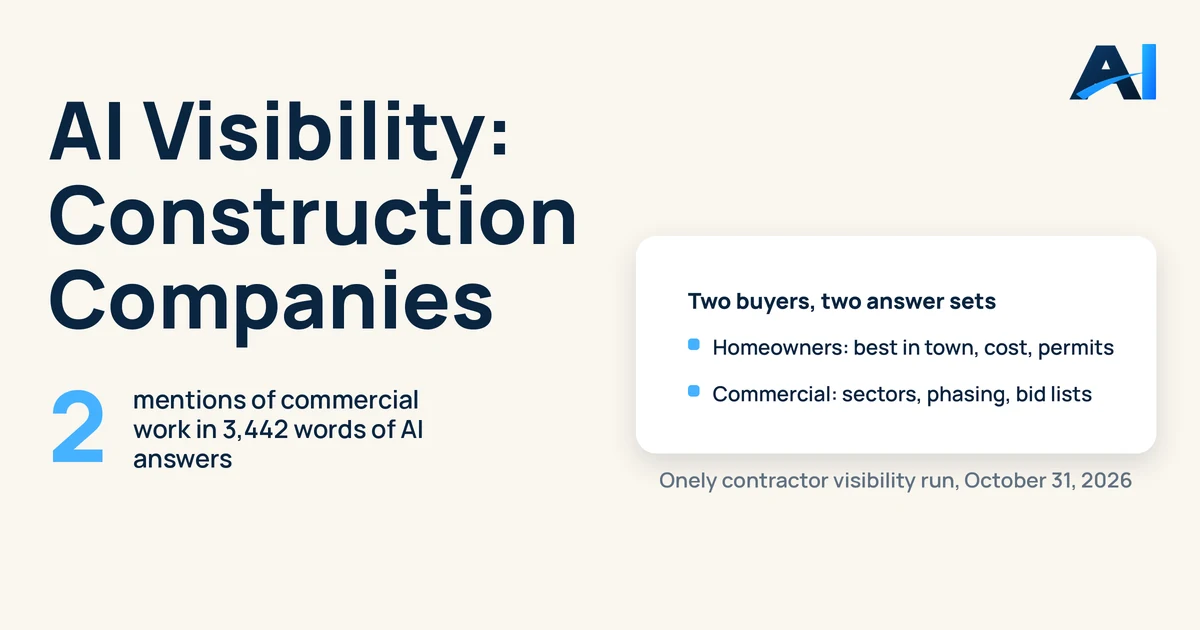
One split matters first. Homeowner and commercial work are won in different answers, with different questions, proof, and sources. Most advice, and most AI answers, only cover the homeowner side. This guide covers both, then the five fixes and a five minute test.
The questions buyers ask
Buyers rarely start with your name. They start with a project and a worry, and the wording changes completely depending on who is buying.
Homeowners and residential buyers ask questions like these:
- Who are the best custom home builders or remodelers in my town?
- How much does a kitchen remodel, an addition, or an ADU cost here, and how long does it take?
- What permits are needed for this kind of project?
- How do I check a contractor licence and insurance?
- Who builds a specific type of project, such as an addition, an ADU, or a design build home?
Commercial buyers, owners reps, facilities managers, and procurement teams ask a different list:
- Which general contractors have built medical office, warehouse, retail, or office space in this region?
- Who can work in an occupied building without shutting us down?
- How does phasing affect a renovation schedule?
- What should a capability statement show before we put a firm on a bid list?
- How are shortlists formed for a project like ours?
That second list is mostly missing from AI answers right now. Onely ran a contractor visibility query on five engines on October 31, 2026: ChatGPT with web search, Google AI Overview, Google AI Mode, Gemini, and Gemini through Google Search. The five answers totalled 3,442 words. The word local appeared 54 times, homeowner 14 times, and commercial twice. Mentions of multi location, national, enterprise, franchise, manufacturer, or business to business work were zero in all five.
For a residential firm, the fight is for the homeowner questions, answered well. For a commercial firm, you have to publish for your buyers' project questions before any firm like yours is named at all. AI Deployment Partner works with firms on both sides, see aideploymentpartner.com/who-we-help/construction.
Why nationals, platforms, and directories win today
Big builders and franchises win on volume: more locations, project pages, reviews, and mentions give AI a thicker record with fewer contradictions.
Platforms win because AI reads them instead of the firm. In BrightLocal's August 2026 study of local AI search, based on 60,970 checks across 1,355 business locations and 1,967,762 citations, Google Business Profile made up 28.63 percent of all citations in the table and was cited for 94.17 percent of businesses. Yelp made up 9.53 percent in the table. BrightLocal's own key findings text gives a different Yelp share, so this guide uses the table figure. For ChatGPT specifically, Yelp was the top local source by a wide margin, with 99,281 citations out of 162,966 ChatGPT citations in the table, and Yelp appeared as a source in 80 percent of ChatGPT answers.
The trade directories sit far behind the big two. In BrightLocal's service businesses cut, the closest cut to the trades, with 166,499 citations, Google Business Profile was 45 percent, Yelp was 12.3 percent, Facebook was 4.40 percent, the Better Business Bureau was 1.60 percent, the Angi list was 1.40 percent, and Houzz was 0.70 percent. Thumbtack and HomeAdvisor were each 0.50 percent, BuildZoom 0.10 percent. There is no construction category cut in that study, so this cut is a proxy, not a construction sample.
Lead marketplaces win a third way: the marketplace becomes the name the engine repeats, while the contractor rents the lead. A firm with only a homepage, a photo gallery, and a contact form gives AI nothing to cite. Photos without facts cannot be quoted, however good the work looks in person.
What AI reads for a construction company
AI builds its picture from the public record, in roughly this order.
First, the profiles. Your Google Business Profile comes first for Google AI answers, and your Yelp page comes first for ChatGPT, for the reasons in the BrightLocal figures above. Bing Places matters too, because ChatGPT leans on Bing search. Keep all three claimed, complete, and identical in facts.
Second, your own website, the long tail that decides close calls. About 93 percent of domains cited in BrightLocal were individual business websites. AI reads it as service pages, one per service and place or sector, and project pages with extractable attributes: what was built, where, for whom, sector, size, constraint, and outcome.
Third, reviews, read for more than stars. A review naming the work and place gives AI usable language. Generic praise gives it neither detail nor confidence.
Fourth, mentions on sites AI trusts for this trade: Houzz, the Better Business Bureau, LinkedIn, your chamber and home builders association, and supplier installer listings. Together they confirm you are what your site says.
Fifth, consistent facts everywhere, with schema as a floor, not a lever. Keep Organization, LocalBusiness or GeneralContractor, Service, and breadcrumb data accurate. Google Search Central says there is no special schema needed to appear in AI Overviews or AI Mode. Ahrefs tested this in May 2026, matching 1,885 pages that added JSON LD schema against about 4,000 controls: plus 2.4 percent for Google AI Mode and plus 2.2 percent for ChatGPT, both indistinguishable from noise, and minus 4.6 percent for AI Overviews. Every page tested already had 100 or more AI Overview citations, so it tests pages already cited, not pages starting from zero.
What does move the answer is quotable substance. In the Princeton GEO study (Aggarwal et al., KDD 2024, benchmark of 10,000 queries), generative engine optimisation boosted visibility by up to 40 percent, measured as share of the generated answer. In Table 1, Quotation Addition scored about plus 41 percent, Statistics Addition about plus 31 percent, and Cite Sources about plus 27 percent. For a source ranked fifth, Cite Sources raised visibility by 115.1 percent. Keyword stuffing performed worse than no optimisation. The percentages are directional, since the main experiments used the authors' own engine built on GPT 3.5, but the order is useful: quote real people, publish real numbers, cite real sources.
The five fixes, in order
1. Lock one plain description and use it everywhere.
One short paragraph: trade, project types, service area, who the work is for, and what you do not do. Use the same words on your site, Google Business Profile, Yelp, Bing Places, LinkedIn, and every directory. This fixes misclassification, where a commercial firm gets described as a domestic builder because listings disagree.
2. Give every service its own answer first page.
One page per service, mapped to buyer questions, not only keywords. Answer first under each heading: what it involves, the cost and timeline ranges you publish for your market, permit and process facts for your area, and proof. If you do both residential and commercial work, separate the pages or sections, and test each key page for service, location, and sector together. A generic services page cannot be matched to a specific question.
3. Turn finished projects into citable case studies.
For each project you want more of, publish the client type, the sector, the location, the size, the scope, the constraint, what was done, and the outcome, with a named contact path. For commercial firms, add a downloadable capability statement. The gap here is wide. In IdealRev's review of 20 commercial construction websites in 2026, not one of the 20 offered a downloadable capability statement. The same review found five of the twenty took between 16 and 26 seconds to load on mobile, the best sites carried eight to twelve testimonials while several carried none, and only three of the twenty had a contact page with an actual named person on it. Label it for what it is, a review of 20 sites: project pages with no client, size, named contact, or capability statement give AI, and a buyer's rep, almost nothing to extract.
4. Build the review and listing record AI actually reads.
Ask steadily at closeout, and ask customers to name the project type and place in their own words. Work Google and Yelp first, then complete Houzz, Better Business Bureau, Angi, HomeAdvisor, and association profiles with identical facts. Never pay for reviews or offer anything in return. Bought praise reads as generic, and generic is what AI cannot use.
5. Test on a fixed question set and retest.
Pick ten to twenty real buyer questions, with residential and commercial questions kept in separate lists. Ask them in ChatGPT, Google AI, and Perplexity in a logged out or private window, and record who is named, who is cited, and who appears instead of you. Repeat on a set cadence, the same questions the same way. Track three numbers separately: mentions, citations, and inquiries. A mention is not proof of endorsement, and a citation is not a lead. Most AI citations never produce a click, so sessions alone under report visibility. Pew Research Center, July 22, 2025, studying 900 US adults and 68,879 Google searches, found users clicked a traditional result on 8 percent of visits with an AI summary, against 15 percent without one, and a link inside the summary on 1 percent. Pew covered all search, not local buying, so use it for the behaviour shift only.
Five minute self test
Open a private or logged out window and ask three questions: a best builders or best remodelers question for your town, a project type plus region question if you do commercial work, and a cost or timeline question your firm should own.
For each answer, check: are you named, is the description correct, which sources are cited, and is any cited page your own? Then check one fact, phone or service area, across Google, Yelp, and your website. Any mismatch or wrong description maps back to one of the five fixes. That map is your work list.
What not to bother with
Do not buy schema packages sold as a citation lever. The Ahrefs matched pair test and Google's own guidance both point the other way. Keep your structured data accurate, and spend the rest of the effort on pages, proof, and listings.
Do not duplicate town pages with only the place name changed. Thin, repeated pages give AI nothing new to quote.
Do not repeat your company name as a tactic, publish thin AI written articles, or state invented projects, credentials, or permit rules as if they applied everywhere. Costs, timelines, and permits vary by place. Publish the facts for your own market and leave universal claims out.
Do not pay for reviews, and do not pay anyone who promises placement in AI answers. ChatGPT does not sell placements in its answers. What can be built is the record the answer is drawn from.
One labelled context line: AGC of America and Sage (2026 outlook, 951 respondents, fielded November 4 to December 15, 2025) report AI use by function at 45 percent for office work, 23 percent for estimating, and 20 percent for design and preconstruction. Their 61 percent headline is a combined metric, in effect 100 minus the 39 percent who selected none of the above, so it overstates current use, and it is about firms adopting AI, not buyers finding firms through AI.
Questions owners ask
Why does AI name big builders and directories instead of my company?
Because it can find them, describe them, and back them from profiles, reviews, and project pages. A national builder has that record at scale, and a directory has it in a clean, structured form. A thin site, with a gallery and a contact form and no project facts in text, gives AI nothing to quote, so the name it can support wins instead.
Do I need different work for residential and commercial jobs?
Yes. The questions differ, the proof differs, and the sources differ. Homeowner answers lean on your profile, your reviews, and your service pages. Commercial answers lean on documented expertise, sector specific project pages, and a capability statement a rep can check. AI answers today are built almost entirely for homeowner work, per Onely's October 31, 2026 run across five engines, so a commercial firm has to publish for its buyers' project questions directly. A firm that does both needs both records, kept separate and consistent.
How long until a construction company starts showing up in AI answers, and how will I know?
Listing fixes and new pages can be crawled within weeks. A consistent record takes longer: guides for this trade put first movement at about 60 to 90 days, with meaningful change later, and no honest source guarantees a date. You will know from the fixed question set, retested the same way, not from a single ask or a traffic chart.
If you want to know where your company stands before you change anything, run the Free AI Visibility Checker at aideploymentpartner.com/free-ai-visibility-check. It shows what AI can and cannot say about your company today, which is the starting point for every fix above. For the construction specific picture, see also aideploymentpartner.com/who-we-help/construction.
Want a second set of eyes?
We can review where AI may help your business, prioritize realistic opportunities, and decide whether the best first step is an integration, an AI workflow, or custom software.
Book Free AI AuditLooking specifically at ChatGPT and AI discovery? Request a free AI Visibility Checker. You can also see how we improve AI search visibility.
Sources and further reading
The guides combine practical implementation advice with the public references below. Hypothetical examples are labeled and are not customer results.
- BrightLocal: Where to Get Local Citations for AI Search (August 2026)
- Onely: AI Search Optimization for Contractors (run October 31, 2026)
- Aggarwal et al.: GEO, Generative Engine Optimization, KDD 2024
- Ahrefs: We Tracked 1,885 Pages Adding Schema (May 2026)
- Pew Research Center: Google Users and AI Summary Clicks (July 22, 2025)
- IdealRev: SEO for Construction Companies (2026 review of 20 commercial construction websites)
- AGC of America and Sage: 2026 Construction Hiring and Business Outlook
- Google Search Central: AI Features and Your Website