
AI Search
AI Visibility for Trucking Companies: How to Be the Company AI Recommends
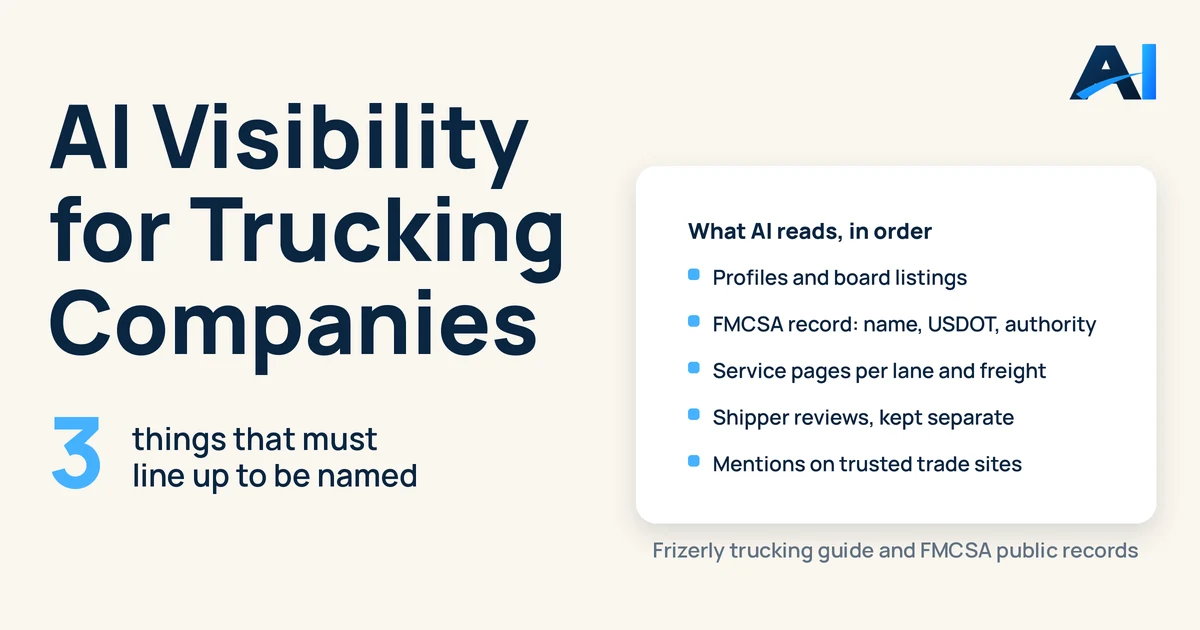
A trucking company gets named in an AI answer when three things line up: AI can find it in the searches behind the answer, describe it in one plain sentence (what freight it hauls, which lanes and regions it serves, and what equipment it runs), and back the name with quotable proof. Shippers and brokers ask different questions than drivers, and the two records must stay separate. This guide covers the questions shippers and brokers ask, what AI reads in order, and the five fixes.
The short answer
A trucking company gets named in an AI answer when three things line up. The AI can find the company in the searches behind the answer. It can describe the company in one plain sentence: what freight it hauls, which lanes and regions it serves, and what equipment it runs. And it can back the name with proof it can quote: service pages per lane and freight type, a public record that matches everywhere, and reviews from shippers that name the work.
Miss any one and the AI names someone else: a large carrier with a thicker record, a load board, or a directory that described the lane better.
One word causes confusion first. In trucking, visibility usually means freight visibility: tracking a load and its estimated arrival. That is software from vendors such as Trimble and Transporeon, and it is a different subject. This guide is about AI search visibility: whether ChatGPT, Google AI, and Perplexity name your company when a shipper or broker asks for a carrier.
The questions shippers and brokers ask
Shippers and brokers rarely start with your name. They start with a load, a lane, and a diligence check.
- Which carriers run this lane, and who hauls this type of freight here?
- Who has capacity for regular loads on this route, or for a one off move?
- Who can handle this specialized equipment need, such as flatbed, refrigerated, step deck, or oversize work?
- Is this carrier properly authorized, insured, and safe to use?
- How do I check a carrier's USDOT number, operating authority, and safety record before I book?
A carrier's legal name, USDOT number, operating authority, insurance filings, and safety record are public records, and shippers and brokers check them during diligence. If the name and facts on your website and listings do not match that public record, the AI answer and the diligence check tell two different stories, and trust goes to the carrier whose record lines up.
Drivers ask a completely different list, about pay, home time, equipment, and hiring areas. Those questions matter for recruiting, and they belong in a separate record, covered below.
Why load boards, directories, and large carriers win today
Large carriers win on volume. More terminals, lanes, service pages, and mentions give AI a thicker record with fewer contradictions, so the description is easier to build and safer to repeat.
Load boards and directories win because AI reads them instead of the carrier. A board or directory page already lists the company in a clean structure, by place, freight type, and equipment, even when the carrier's own site says almost nothing in text. The board becomes the source the answer is drawn from, and often the name the answer repeats.
Platforms shape the local layer too. In BrightLocal's August 2026 study of local AI search, Google Business Profile was the largest single citation source for local businesses overall, and ChatGPT leaned heavily on Yelp in local answers. A trucking company is not only a local business, since its work runs across lanes and regions, but its terminal and office record still feeds that layer. A thin or inconsistent profile weakens the one location record AI can check quickly.
A small or mid size carrier with only a homepage, a logo, and a quote form gives AI nothing lane specific to quote. It may be the right carrier for the load, but the answer can only name companies it can describe.
The two audiences that make trucking distinct
Most trades have one buyer. Trucking has two audiences reading the same name, and their reviews and questions must stay distinct.
The first audience is shippers and brokers. Their reviews and questions are about freight: was the load picked up and delivered as agreed, was communication clear during the move, was the equipment right, and would they book again. Those are the reviews that support a recommendation to another shipper.
The second audience is drivers. Their reviews and questions are about the job: pay, home time, dispatch, equipment condition, and hiring. Mixed into the same pages and profiles without separation, they blur the picture AI builds of what the company offers a shipper. A page answering driver hiring questions is not evidence that a carrier is right for a freight move, and a shipper service page is not a recruiting page.
Frizerly's trucking guide makes the same separation as a publishing step: separate shipper acquisition from driver recruitment, so their pages do not compete for the wrong intent. Keep the two records separate in pages, in review asks, and in profiles, and each audience gets an answer built for its own decision.
What AI reads for a trucking company
AI builds its picture from the public record, in roughly this order.
First, the profiles. Your Google Business Profile for a real terminal or office, and your listing record on the directories and boards where shippers already look, claimed and complete. Only list real facilities. Serving a city does not create a location there.
Second, the public authority record, stated plainly and consistent everywhere. Your legal name, USDOT number, operating authority, insurance filings, and safety record are public records through the Federal Motor Carrier Safety Administration. State the legal name and USDOT number the same way on your website, your profiles, and your listings, matching that record exactly. Do not round it, shorten the name on one site and spell it in full on another, or publish equipment and coverage claims the record and the operation cannot support.
Third, the company website, read as service pages. One clear page per freight type and per important lane or region, stating what you haul, what equipment you run, where you run it, what information a quote needs, and what loads you do not accept. A single generic services page cannot be matched to a specific lane or freight question. Frizerly's framework for a trucking page is useful here: service, geography, proof, and answer, checked on every important page.
Fourth, shipper reviews, read for more than stars. A review that names the freight, the lane, and how the move was handled gives AI usable language for a shipper answer. Driver reviews support recruiting answers. Keep the ask and the placement matched to the audience, so shipper proof is easy to find where shippers look.
Fifth, mentions on sites AI already trusts for transport: trade associations, chambers, shipper and industry directories, and partner pages that describe your company accurately.
No part of this record can be bought as a guarantee. Frizerly states the point plainly in its trucking guide: no tool can guarantee a Google ranking or a recommendation from ChatGPT, Gemini, or Perplexity, and brand mentions, source citations, and visits are separate outcomes. A mention is not a citation, a citation is not a visit, and none of the three is a booked load.
The five fixes, in order
1. Lock the legal identity and use it everywhere.
One legal name, stated exactly as it appears in the public record, with the USDOT number in the same form, on the website, profiles, directories, and board listings. Add one plain description and use it everywhere too: carrier type, freight types, equipment, lanes and regions, and what you do not haul. This fixes the most basic failure, where AI and a diligence check find two versions of the same company.
2. Give every freight type and key lane its own answer first page.
One page per service that matters: the freight, the equipment, the geography, and the proof, with the answer first under each heading. State what a quote requires, such as dimensions, weight, pickup and delivery points, and timing, and link the page to the right quote path. Publish a lane page only when the route matters commercially and you can keep distinct, current information on it. Pages that change only the city names give a shipper, and AI, nothing new.
3. Publish the diligence answers on the company site.
A plain page that answers the checks a shipper or broker runs anyway: legal name, USDOT number, operating authority, how insurance filings and safety records can be checked, and who to contact to verify them. Keep it factual, keep it current, and keep it consistent with the public record. Do not add claims about safety or insurance beyond what the record shows.
4. Build the shipper review record, kept separate from driver reviews.
Ask shippers and brokers at delivery, in their own words, and ask them to name the freight type and lane where they can. Keep driver recruiting reviews and hiring pages in their own place, serving drivers well without mixing the two signals. Never pay for reviews or offer anything in return.
5. Test on a fixed question set and retest.
Pick ten to twenty real shipper and broker questions, covering lanes, freight types, capacity, specialized equipment, and diligence. Ask them in ChatGPT, Google AI, and Perplexity in a logged out or private window, and record who is named, who is cited, and whether the description of your company is correct. Keep driver questions in a separate test list. Repeat the same questions the same way on a set cadence, and track mentions, citations, and qualified inquiries as three separate numbers, because that is what they are.
Five minute self test
Open a private or logged out window and ask three questions: a carrier question for your best lane, a freight type plus equipment question your company should own, and a diligence question using your company name and USDOT number.
For each answer, check: are you named, is the description correct, which sources are cited, and is any cited page from the company site? Then check one fact, your legal name or USDOT number, across your website, your Google profile, and one directory listing. Any wrong description or mismatch maps back to one of the five fixes.
What not to bother with
Do not confuse the two kinds of visibility work. Buying freight tracking software may be right for operations, but it does not make AI name your company to a shipper. Judge each purchase on its own job.
Do not create profiles for cities you only drive through, or lane pages with only the place names changed. Frizerly gives the same warning: serving a city does not mean the company has an eligible location there, and a repeated lane page creates a maintenance burden with little help for shippers.
Do not blur the business model. State whether the company is an asset based carrier, a broker, or another provider, in those plain terms, and do not let a page imply the company owns equipment it does not own, or accepts freight it does not accept.
Do not pay for reviews, and do not pay anyone who promises placement in AI answers. No software or service can guarantee a recommendation. What can be built is the record the answer is drawn from.
Do not judge this work by website visits alone. A mention, a citation, and a visit are separate outcomes, and neither a mention nor a citation automatically produces a visit. Judge it by the fixed question set and by whether qualified shipper inquiries follow.
Questions owners ask
Why does AI name large carriers and load boards instead of my company?
Because it can find them, describe them, and back them. A large carrier has service pages, listings, and mentions at scale, and a load board lists carriers in a clean structure by lane and freight type. A carrier with a thin site and an inconsistent listing record gives AI nothing specific to quote, so the name it can support wins instead.
Should shipper reviews and driver reviews be handled differently?
Yes. They answer different decisions. Shipper and broker reviews prove how freight was handled, and they support recommendations to other shippers. Driver reviews prove what the job is like, and they support recruiting. Keep the pages, the review asks, and the test questions separate for each audience, so neither record weakens the other.
How long until a trucking company starts showing up in AI answers, and how will I know?
There is no published timeline for when listing fixes and new service pages get picked up. A consistent record across the public authority record, the website, profiles, and reviews takes time to build, and no honest source guarantees a date. You will know from the fixed question set, retested the same way, recording mentions and citations separately, not from a single ask or a traffic chart.
If you want to know where your company stands before you change anything, run the Free AI Visibility Checker at aideploymentpartner.com/free-ai-visibility-check. It shows what AI can and cannot say about your company today, which is the starting point for every fix above. For the trucking specific picture, see also aideploymentpartner.com/who-we-help/trucking-fleet.
Want a second set of eyes?
We can review where AI may help your business, prioritize realistic opportunities, and decide whether the best first step is an integration, an AI workflow, or custom software.
Book Free AI AuditLooking specifically at ChatGPT and AI discovery? Request a free AI Visibility Checker. You can also see how we improve AI search visibility.
Sources and further reading
The guides combine practical implementation advice with the public references below. Hypothetical examples are labeled and are not customer results.