
AI Search
AI Visibility for Auto Dealerships: How to Be the Store AI Recommends
A dealership gets named in an AI answer when the store is easy to describe and easy to check, with a record that agrees everywhere: a complete profile for each department, service and parts pages AI can read, and reviews that name the department the buyer is asking about. The split that decides this trade is which question is being asked: buyers and service customers ask different questions, and AI builds a different shortlist for each. This guide covers the questions, what AI reads in order, and the five fixes.
The short answer
A dealership gets named in an AI answer when the store is easy to describe and easy to check. The AI can say in one plain sentence what the store sells, which franchises it holds, and where it serves. It can back the name with a record that agrees everywhere: a complete profile for each department, service and parts pages it can read, and reviews that name the department the buyer is asking about.
The split that decides this trade is which question is being asked. Vehicle questions, who has a model in stock at a price, are mostly answered from inventory platforms and manufacturer sites, because that is where the live feed lives. Service, parts, and local trust questions are answered from the store's own record, and that is the layer a single store can win.
The questions buyers and service customers ask
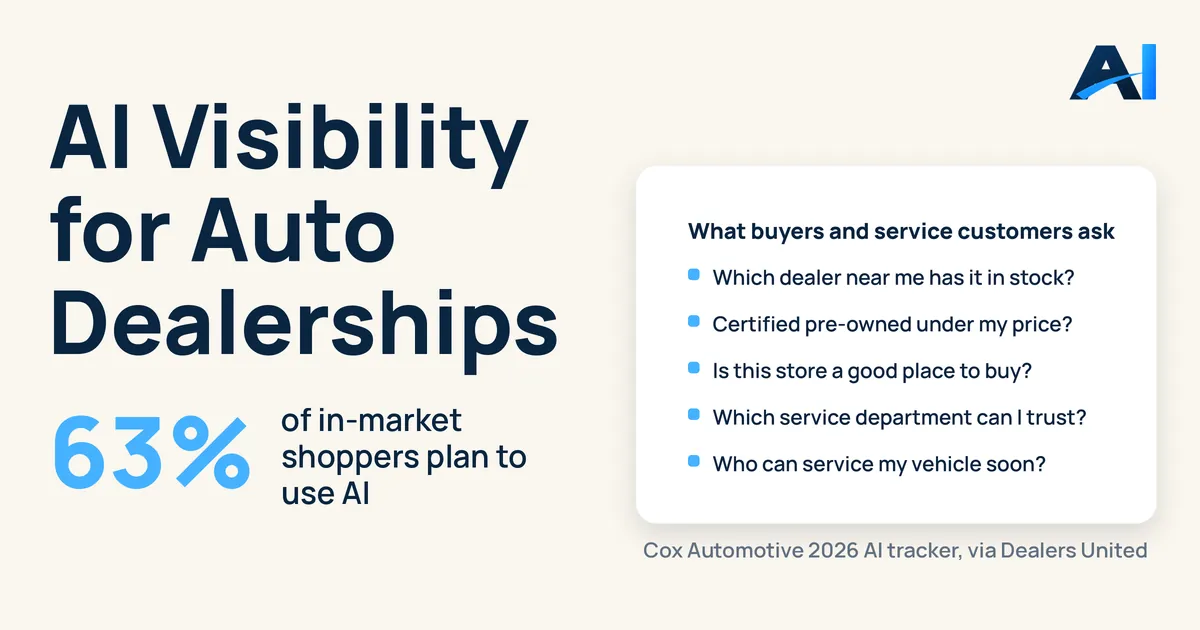
Buyers and service customers ask different questions, and AI builds a different shortlist for each.
Buyers ask:
- Which dealer near me should I buy this model from, and who has it in stock?
- Who has a certified pre-owned vehicle under my price near my town?
- Is this store a good place to buy a car, and what do buyers say about its finance office?
- Where can I get a fair value for my trade-in?
Service customers ask:
- Which service department near me should I trust for this brand?
- Who can service my vehicle soon, and what does that service cost?
- Where should I buy genuine parts, or get a repair done right the first time?
AutoLander's dealership measurement guide groups tracked questions the same way, by job: finding a dealer, finding a specific car, reputation, trade-ins, and service, with fixed ops questions tracked separately from sales questions. That separation matters because a store can be the default answer for service in its town and absent from the vehicle answers, or the reverse. One score for the whole store hides which half is missing.
The demand is real and still early. Dealers United, citing Cox Automotive's 2026 AI in Auto Retail Tracker, reports that 63 percent of in-market shoppers plan to use AI on their next vehicle purchase, while only 29 percent of dealers have started adjusting to AI search. Brian Fidler's dealership guide puts today's share plainly: AI search is still a small, single digit share of dealer shopping journeys, but the buyer who asks an assistant a direct purchase question is deciding, not browsing. Both points can be true at once, and together they set the proportion: build the record now, while the work is cheap, and do not move the whole budget to chase it.
Why inventory platforms and manufacturers win the vehicle questions
A vehicle question needs live facts: a specific unit, a trim, a price, and whether it is still available. Inventory platforms and manufacturer sites hold those facts in a feed that updates, structured the same way for every store. A single store's website, built by a platform vendor and changed slowly, rarely matches that freshness or structure.
So AI answers the vehicle question from the feed it can read. Dealers United's tracking method names the pattern in its own columns: the sources cited in dealer answers include listing and review platforms such as Cars.com and Google reviews alongside the store's own pages. The platform becomes the source, and often the name the shopper remembers.
There is a second, quieter problem on the store's own site. Fidler names it directly: vehicle detail pages that render behind JavaScript bots cannot fully execute, and vehicle markup that does not exist or does not validate, make inventory invisible to the layer AI assistants read from. He also notes that Google retired its vehicle listing rich result in September 2025, so the markup's value now is machine legibility, not a special display. A store cannot fix the platform's feed advantage, but it can stop hiding its own inventory from the readers it does control.
Manufacturers win for a related reason. A brand question about trims, warranty terms, or a model's specifications is answered from the manufacturer's own pages, which are the authority for that vehicle. The store's opening is not the vehicle facts. It is everything around the vehicle that only the store can prove: its service record, its people, its reviews, and its local standing.
What AI reads for a dealership
AI builds its picture of a store from the public record, in roughly this order.
First, the profiles, one per department. A complete Google Business Profile for the store, with the sales, service, and parts departments stated accurately, hours per department included. In BrightLocal's August 2026 study of local AI search, Google Business Profile was the largest single citation source for local businesses overall, and ChatGPT leaned heavily on Yelp in local answers. A dealership is a local business at this layer, whatever its inventory does nationally. A thin profile, or one set of hours covering departments that close at different times, weakens the fastest check AI runs.
Second, the identity, stated one way everywhere. Fidler's test is reconciliation: the same store name, rooftops, franchises, metro, and service area across the website, the Google profiles, the manufacturer locator entry, directories, and reviews. A store that appears under three name variants has made the picture harder to build, and AI names the store it can describe without guessing.
Third, the website, read as department pages. One clear page per job: new and used sales by franchise, service with the work it performs and how booking works, parts, financing and trade-in, each opening with a direct answer in plain text. Assistants pull passages, not pages, in Fidler's phrase, so a page that buries its answer under video and award badges gives the model nothing to lift. Specific claims are what get quoted: what the store stocks, services, and stands behind, stated with numbers the store can prove, not "great selection" language no machine can cite.
Fourth, reviews, read by department. A review that names a service visit, the work done, and how it was handled is evidence for a service answer. A review that names the buying experience is evidence for a sales answer. Mixed together with no department signal, the store's strongest proof blurs. Ask for reviews where the experience happened, at the service desk and at delivery, in the customer's own words naming the department and the job.
Fifth, mentions on sites AI already trusts for cars and for the town: manufacturer and dealer association pages, local news, community sources, and the listing platforms themselves, each describing the store accurately.
No part of this record buys a recommendation. Fidler states the limit plainly: no vendor, tool, or fix can guarantee a store will be named. Dealers United and AutoLander make the same practical point from measurement: the systems change from run to run, so no single answer is fixed. A mention, a citation, and a visit are separate outcomes, and none of the three is a sold vehicle.
The five fixes, in order
1. Fix the identity and the profiles first.
One store name, used the same way on the website, the Google profiles, the manufacturer locator, directories, and listing platforms. Complete each department's profile separately: correct hours, correct phone path, services stated plainly. This is the cheapest fix and the one every wrong answer traces back to.
2. Give service and parts their own answer first pages.
A service page that opens with what the department services, which brands and work it takes, how to book, and what a common service costs when the store publishes prices. A parts page that says what it stocks and how ordering works. These pages serve the questions a single store can actually win, and most dealer sites give them the least text on the site.
3. Make the vehicle pages readable, and state only live facts.
Check that vehicle detail pages render their facts as page text a crawler can read, and that vehicle markup validates. Then accept the limit honestly: publish inventory facts the feed keeps current, and do not hand write stock or price claims on static pages that go stale. A wrong in stock answer costs more trust than no answer.
4. Build the review record by department.
Ask service customers at pickup and buyers at delivery, separately, and ask each to name the department and the job in their own words. Answer reviews on the profile where they land. Never pay for reviews or offer anything in return. The goal is a record AI can sort by department, because buyers ask by department.
5. Test on a fixed question set, split by job, and retest.
Pick 10 to 25 real questions across finding a dealer, specific cars, reputation, trade-ins, and service. Ask each one logged out with your town named, following Dealers United's manual check method, and ask each one at least three times per assistant, following AutoLander's repeat run method, and record who is named, who is cited, and what the answer gets wrong about your store. Keep the vehicle questions and the service questions in separate counts. Repeat monthly on the same set, and judge the work by the service and trust counts first, because that is the layer these fixes move.
Five minute self test
Open a private or logged out window and ask three questions: a service question for your best brand in your town, a reputation question using your store's real name, and a specific car question for a model you stock.
For each answer, check: are you named, is the description correct, which sources are cited, and is any cited page yours? Then check one fact, your service hours, across your website, your Google profile, and one listing platform. A mismatch or a missing department maps back to one of the five fixes.
What not to bother with
Do not chase live inventory questions with static content. Writing blog posts that claim stock or prices the feed will contradict teaches AI, and shoppers, that the store's pages cannot be trusted for the facts that matter most.
Do not buy a visibility score with no method behind it. AutoLander's warning is the right test for any vendor, including this guide's publisher: ask which assistants were asked, how many times each question ran, and whether you can read the raw answers. A number without those three answers tells you very little.
Do not pay anyone who promises placement in AI answers. No one can sell a spot in the answer. What can be built is the record the answer is drawn from.
Questions owners ask
Can a single store beat the inventory platforms in AI answers?
For live vehicle facts, usually not, and it does not need to. The platforms hold the feed. The store's winnable layer is service, parts, reputation, and local trust questions, where the answer is built from the store's own profiles, pages, and reviews. Win that layer first and measure it separately.
Should sales and service really be tracked separately?
Yes. The question sets, the sources, and the shortlists differ, and a combined score hides which half is missing. AutoLander groups tracked questions by job for this reason, with service tracked apart from sales, and Dealers United records position, competitors, and sources per answer so the split stays visible.
How long before fixes show up in AI answers?
Answers change from run to run, so judge on repeated runs of a fixed question set, monthly, not on one check. Dealers United re-runs its manual check 60 to 90 days after fixes go live and plans on that window for foundational movement. Treat any promised date as a sales claim, not a schedule.
You do not need an enterprise platform to answer the three questions for your own store. Our free AI visibility check answers them at local scale: whether AI names your store when a buyer asks, for sales and for service, what it says about you, and who it names instead. It is a first cut, not an enterprise audit, and for owners who want those findings worked through by a person, with the fixes listed in order, that is our AI Visibility Audit.
Want a second set of eyes?
We can review where AI may help your business, prioritize realistic opportunities, and decide whether the best first step is an integration, an AI workflow, or custom software.
Book Free AI AuditLooking specifically at ChatGPT and AI discovery? Request a free AI Visibility Checker. You can also see how we improve AI search visibility.
Sources and further reading
The guides combine practical implementation advice with the public references below. Hypothetical examples are labeled and are not customer results.