
AI Search
AI Visibility for Medical Spas: How to Be the Practice AI Recommends
When a patient asks ChatGPT, Perplexity, or Google AI for a med spa, the answer is a short list, usually two to four names, with a reason for each one. The practices named are the ones AI could verify: a named treatment, in a named place, with current reviews, consistent facts, and a booking path it could check. This guide covers the questions patients ask, what AI reads in order, and the five fixes.
The short answer
When a patient asks ChatGPT, Perplexity, or Google AI for a med spa, the answer is a short list, usually two to four names, with a reason for each one. The practices on that list are not always the best known ones in town. They are the ones the AI could verify: a named treatment, in a named place, with current reviews, consistent facts, and a booking path it could check.
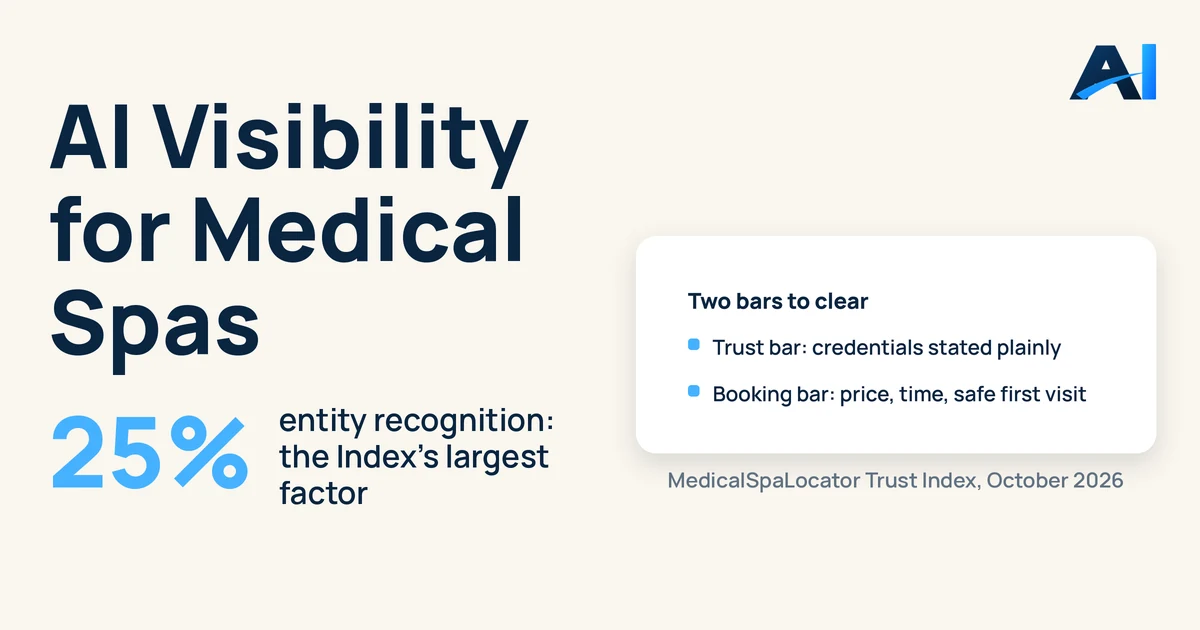
A med spa sits in a harder spot than most local businesses. The questions sound like shopping questions, but the treatments are clinical. So the AI has to clear two bars at once before it names you: a trust bar, because the service affects a person's body, and a booking bar, because the patient wants a price, a time, and a first visit that feels safe. Most practices work on the booking side, with ads and social posts. The trust side, the record the AI reads, is usually the thin part.
This guide is the fix order: what patients actually ask, why chains, platforms, and directories win today, what the AI reads for a med spa, the five fixes in order, a five minute self test, and what not to bother with.
The questions patients ask
Patients rarely start with your name. They start with a treatment and a worry. The questions that decide who gets named sound like these:
- Who is good for Botox near me if I want a natural look?
- How much does laser hair removal cost here, and how many sessions does it take?
- What is the difference between a med spa and a dermatology office for this treatment?
- Who performs the treatment, and what are their credentials?
- Is there a med spa near me that takes Saturday appointments and publishes its prices?
Every one of those questions needs a specific fact to answer it: a treatment name, a price or a range, a provider, a location, a day. A practice that publishes those facts in plain text can be matched to the question. A practice whose site says "rejuvenating treatments, call for details" cannot, however good the work is.
Why chains and directories win today
Three kinds of competitor take most of the names in these answers.
National chains and multi-location groups win on consistency. The same name, services, and booking path, repeated across many locations and profiles, give the AI a record with no contradictions to trip over.
Booking and directory platforms win on structure. MedicalSpaLocator, a med spa directory, listed more than 18,173 practices across more than 1,000 US cities in October 2026, each with services, prices, and providers in the same format. In Spearleaf's August 2026 study of what ChatGPT cited for med spas, directory sites were the most cited sources, with two med spa directories each appearing in 5 of the 18 markets tested. When a directory can answer a treatment question and your own site cannot, the AI cites the directory and names whoever the directory describes best.
Well documented independents win the rest. They tend to share the same habits: a page per treatment, published prices, providers named with credentials, and reviews that mention the treatment by name.
There is one more pattern worth knowing. In that same Spearleaf study, only 34.1 percent of markets kept the same first pick between asks, across the 12 services tested. AI answers for this trade move. That is not a reason to chase every swing. It is a reason to build the record once, properly, and then judge it monthly on the same fixed questions.
What AI reads for a med spa
The AI builds its picture from the same public record a careful patient would check, only faster and with less patience for gaps.
Your Google Business Profile is the single biggest source. In BrightLocal's August 2026 study of local AI answers (60,970 checks, 1,355 locations, 1,967,762 citations), Google Business Profile made up 28.63 percent of all citations and was cited for 94.17 percent of businesses. Yelp made up 9.53 percent overall and appeared as a source in about 80 percent of ChatGPT's local answers. About 93 percent of the domains cited were individual business websites, which is why your own treatment pages still carry the most weight in the end.
Your treatment pages are where the match happens. One page, or one tightly structured section, per core treatment: what it is, who it suits, who performs it, how long it takes, what it costs or the range it starts in, and how to book. MedicalSpaLocator's Chicago pull of October 23, 2026 found published Botox prices running $10 to $16 per unit, with a median of $13.50, and lip filler at $449 to $750 per syringe. The point is not those numbers, which are one city on one date. The point is that the practices that published prices were the comparison set. A practice with no published price is left out of a price question entirely.
Your providers and supervision, stated plainly, are the trust record. Name the providers, state their credentials and the practice's medical supervision as plain facts, and claim nothing beyond what the practice can stand behind. In MedicalSpaLocator's own AI Visibility and Trust Index, which scores a practice from 0 to 100 across five AI engines, entity recognition, being confirmed as one practice across independent sources, is the largest single factor at 25 percent, ahead of content depth at 15 percent. That Index is the directory's own method, not an industry standard, but its order matches what the other evidence shows: identification and trust come before persuasion.
Your reviews are the third-party proof, and in this trade they need care. A review that names the treatment gives the AI both confidence and language: it can say patients praise a specific service because the reviews actually say so. Generic praise gives it neither.
The five fixes, in order
1. Give every core treatment a matchable page.
Start with the one or two treatments you most want to fill. Each page answers, in plain sentences an AI can quote: what the treatment is, who it suits, who performs it, how long it takes, what a first visit involves, and the price or the starting range. If a fact cannot be published, say what can be asked at a consultation instead of leaving a blank the AI fills with a competitor.
2. Make the practice one confirmable record everywhere.
Name, address, phone, hours, treatment list, and booking link, identical on your website, your Google profile, your booking page, and the directories that list you, including the med spa directories ChatGPT cites. Claim the listings you can claim. Fix the highest authority records first, your Google profile, then directories, then social profiles. Any change, a new provider, new hours, a dropped treatment, goes to every surface on the same day.
3. State credentials and supervision plainly, and nothing more.
List each provider by name with their credentials. State the medical supervision arrangement in one plain sentence. Never claim a license, a qualification, a result, or a treatment outcome the practice cannot support. An overstated claim is a compliance risk on its own, and it gets worse in AI search: an assistant that repeats it puts the claim in front of patients with your name attached.
4. Earn reviews that name the treatment, within the rules.
Ask after a good visit, make it easy, and ask the patient to say what they had done, in their own words. Never offer anything in return for a review, never ask only happy patients, and never script the words. Reply in general terms, without confirming the reviewer is a patient or naming their treatment. That reply discipline matters more in this trade than in most: a careless reply can disclose more than the review did.
5. Close the booking loop, and answer the first-visit questions.
Show current hours, including weekends if you offer them. Link straight to booking from the profile and from each treatment page. State consultation, cancellation, preparation, and downtime answers per treatment, in short FAQ sections. Those first-visit questions, does it hurt, how do I prepare, what does it cost, is there downtime, who performs it, are the exact questions patients ask the AI. A practice that answers them on its own pages gives the assistant a reason to name it for a nervous first-timer.
Five minute self test
Ask ChatGPT, Perplexity, and Google AI the same three questions: the best med spa in your city for your top treatment, the cost question for that treatment, and who performs it near you. Note who is named, what facts are given about you, and whether any of them are wrong.
Then read your top treatment page as plain text, with no styling or photos. Count the sentences an AI could quote as an answer: the treatment, the provider, the price or range, the duration, the first-visit facts. Fewer than three quotable sentences means the page is marketing copy, not a record the AI can use.
Finally, lay your name, address, phone, and hours from five places side by side: your site, your Google profile, your booking page, and two directories. Any difference is a fixable leak, and that count is your first week's work list.
What not to bother with
Do not buy reviews, offer a reward for one, or filter which patients get asked. Apart from breaking platform and regulator rules, bought praise reads as generic, and generic is exactly what the AI cannot use.
Do not publish before and after claims you cannot stand behind. Photos need the patient's written permission, should show a typical result, and should never be retouched in a way that changes the outcome. In AI answers, an exaggerated claim does not stay on your page. It travels, with your name on it.
Do not build a page for every treatment on the menu at once. Two complete, quotable treatment pages beat twelve thin ones. Finish one treatment's record, profile, pages, and reviews, before starting the next.
Do not pay anyone who guarantees an AI recommendation. No one can sell that. What can be built is the record the recommendation is drawn from, and that work is mostly yours to publish.
Questions owners ask
How long does it take for a med spa to start showing up in AI answers?
Judge it the honest way: the same fixed set of patient questions, asked monthly, over a quarter. Single asks swing too much in this trade to mean anything on their own.
Do published prices really change whether AI names a med spa?
Yes, for price questions. An AI can only cite a price that exists in the record. Publishing a clear range or a starting price puts you in the comparison. Withholding it leaves the answer to directories and competitors.
Is a directory listing enough on its own?
No. Directories are heavily cited for med spas, so an accurate, claimed listing helps you be found. But about 93 percent of the domains cited in BrightLocal's study were individual business websites. Your own treatment pages are where the AI confirms the details. The listing gets you into the set. Your pages give it the reason to name you.
If you want to know where your practice stands before you change anything, run the Free AI Visibility Checker at aideploymentpartner.com and ask the same patient questions your buyers ask. It shows what the AI can and cannot say about your practice today, which is the starting point for every fix above.
Want a second set of eyes?
We can review where AI may help your business, prioritize realistic opportunities, and decide whether the best first step is an integration, an AI workflow, or custom software.
Book Free AI AuditLooking specifically at ChatGPT and AI discovery? Request a free AI Visibility Checker. You can also see how we improve AI search visibility.
Sources and further reading
The guides combine practical implementation advice with the public references below. Hypothetical examples are labeled and are not customer results.
- BrightLocal: Where to Get Local Citations for AI Search (August 2026)
- MedicalSpaLocator: How Med Spas Rank in AI Search (2026 Playbook)
- MedicalSpaLocator: AI Visibility and Trust Index for Med Spas (2026)
- Spearleaf: Med Spa SEO and Marketing (August 2026 ChatGPT citation study)
- Videxi: AI Visibility for Med Spas (October 31, 2026)